Showing posts with label RPG Blog Carnival. Show all posts

Monday, March 30, 2026

RPG Blog Carnival: Small Souls in a Big World! - 3DIE6 RPG


Happy Spring. And this month's RPG Blog Carnival transitions from the Very Big, to the Very Small, thanks to Errant Thinking.

Back in '21 or so, I pledged to a little game produced by Deeply Dapper Games as part of that year's Zinequest: 3DIE6.


And playing as a tiny ant-thing is about as small as you'll get in an RPG. Because, as far as I know, no one has developed "Tardigrade, the RPG" yet.

First of all, the game, as you might have intuited, is a d6 system. In 3DIE6 (and its sister games), the three d6's are either combined into a 3d6 additive roll (skill tests) or as three individual dice with individual values (combat) - these being "attack," "defense," and "effect."

But first, the setting. 3DIE6 takes place within "The Shimmer," a subterranean labyrinth of fungus-illuminated tunnels and warrens. Your PC is one of the Roan, an insect that may be a bit human, or alien. We're not sure... 

It's a dangerous and deadly land for a tiny arthropod such as yourself. So much so, that it's good to bring along a friend. Or two. Not as companions, but in your own head. Because each Roan is actually three personalities, selected from the six base archetypes of the game: Brutal, Clever, Nimble, Precise, Resilient, and Vicious. The archetypes are designed not to be across the board equivalent to our familiar basic PC classes, but to overlap or be more setting-specific in our ant-world. And as archetypes, each has its strengths and limitations. 

an example character

So what's up with the three-in-one character? Each Roan is inhabited by three selected archetypes, and may switch in three situations: after a rest (referred to as cocooning), the primary or active personality is killed, or under duress during an encounter (although with penalties for the latter two cases). The idea was born from the system/game originally being designed as a solo system, so an individual player could have access to a "party" of different skills. Regardless, it's also useful for one-on-one play, or a limited party of just a couple of players. Think of it as resource management including the three PCs in your body...

The setting, The Shimmer, has a number of post-apocalyptic undertones. The Queen is fading in virility and power, which allows the Roan to break from their natural hive-mind and explore, seeking resources and propping up their decaying City and Queen. Or striking out on their own.

As a subterranean world, there are plenty of foes: rogue Roan, fungal beings, giant boring worms, spider things, and probably real ants. Combat with the d6 system is fast and fatal.

The zine includes setting background, character creation, the d6 mechanics, a handful of statted foes, and a brief "Tunnel Master" section with some game advice and lightweight random tables for plot, tunnel generating, and loot.

In addition to the 46 page zine version, a 135-page expanded core rulebook is also available. A Second Edition is pending on Kickstarter.


Sunday, February 22, 2026

RPG Blog Carnival: "Dragons, Gods and other Powerful Beings" - Angels and Demons


Damn, been a bit since the Carnival caught my eye/awareness. This month, hosted by Sea of Stars. OK. Let's play. 

Thesis statement: Demons are Tools. Angels are Weapons...

A note: I'll be leaning hard on other researchers and presenters for this one, as I'm not a smart man. As anyone who's read my blog can attest. 

To start at the end: A bit of a review from my recently-completed OSE campaign. As in many campaigns, the acts and deeds of the PCs affect the world. And draw the attention of powerful entities, whether a mortal faction, or the immortals who watch the world. And certainly, the PCs got the attention of Khador, a goddess of law, as they strove against the minions of her Chaos-borne sibling. But Khador was only glimpsed in visions, perhaps as a dream channeled through a relic sword, or after the final battle, as she shed her raiment and strode towards the dawn, a rejuvenated goddess of Spring... 

But who really shook the PCs? This thing.

source

Yeah, it's an avatar for the Lawful side of things.

The demon bound by the Sea Dwarves? Not so much. Mostly just pay for the work to get done to spec and on time. As long as you can handle it throwing shade. "WHAT DO YOU WANT!?!? I WAS NAPPING!" "Don't you people write anything down?"

This guy

Friday, June 6, 2025

June RPG Blog Carnival: Magic Shops


This month's blog carnival is sponsored by Advantage on Arcana and appropriately themed, "Magic Shops and Their Alternatives."

Well, I'd better hop on board before I lose my muse for another several months...

...with the important question: "Why own, when you can rent?"

***

HEY! HEY! HEY! C'mon down to Lucky Eddy's Magic Rentals! 

(On the corner of Rivenbell Road and Langmug Lane - look for the wacky waving wyvern!)

Why buy, when you can RENT?!?

No need to buy an overpriced item from those sketchy elves down the street or that shop run by the bald dude on the river! Especially if you only need it for this quest or mission! Who needs a pack full of unused magical tinker? YOU DON'T!

Lucky Eddy is here to help you lighten that load and set you up for SUCCEESSSS!! No more hauling three swords, "just in case!" We'll get you kitted out and back from that dungeon before the tavern closes!!!

REASONABLE RATES! By the Day, Week, or Month! (Some Exclusions Apply)*

Source

Sunday, June 1, 2025

May RPG Blog Carnival Late Entry: Oaths - The Beguine/Beghard Class for OSE and Shadowdark

Ok, here we are on May 32, and I'm right on time to contribute to the month's Blog Carnival. This time hosted by Tabletop Curiosity Cabinet and themed, "Oaths." So let me share a small introduction to a historic religious community, as well as a player class (OSE and Shadowdark) inspired by them:


The beguines (and their male counterparts, the beghards) were religious lay-communities most active during the 13th - 16th centuries. While not formally monastic in nature, the members typically took vows, most commonly chastity, as well as of charity and religious devotion. Members were also able to quit the role, and return to secular life. 

The communities were typically self-supporting, with their members taking part in cottage industries. These beguinages could be as small as a shared house up to a walled compound. Larger examples contained shops, hospitals, breweries, and cloth mills.

Because many of the beguines came from middle- or upper-class backgrounds, many were literate and wrote treatises and poetry reflecting their faith and the visions that they experienced during contemplation and prayer. This mysticism was a common theme among the communities, as well as the idea of sharing these "visions" through religious or secular texts. Because these publications were outside the orthodoxy and independent of Church doctrine, they were often criticized or suppressed, with the most egregious example being the burning at the stake of Marguerite Porete as a relapsed heretic by the Inquisition.

After all, there is nothing more frightening than a financially independent, literate woman interpreting religious dogma.

Saturday, March 23, 2024

RPG Blog Carnival: Feasts, Foods and Fancy Drinks, oh my!

Crap. It's been literal years since I've contributed to one of these. 

VDonnut Valley is hosting this month's soirée, themed Feasts, Foods and Fancy Drinks, oh my! Well, I can work with a prompt like that. Perhaps from a slightly different angle.

After all, part of being a good host is sometimes being flexible to your guests' dietary restrictions and perhaps preparing a special meal for an honored "foreign" guest...

source

***

The tremoring acolyte stirred the vile concoction. His eyes darted to the poor sod he'd just replaced, still spasming on the floor. Clearly, sampling the offertory meal had not agreed with him.

“Add the next ingredient, worm!” commanded the hooded priest. Taking a shaking hand, the acolyte opened the stained crockery. His eyes watered even more as the acrid, metallic fumes emerged from the crockery as he poured the toxic mixture into the boiling pot.

“Taste the offering. Perhaps you are more worthy to serve His Glory than your predecessor!” A spear butt in his ribs encouraged the acolyte further.

The acolyte glanced at his fellow initiate, now still. With shaking hand and tears in his eyes, he took a spoon to taste the bubbling amalgamation.

Somewhere, in the shadows beyond the priest, a shape began to unfold from space. Slavering jaws emerged as the entity from beyond took in the first, deep, delicious scent of the offering meal...

Friday, April 13, 2018

Lost Tomes 6

Hi +j garrison! Thank you for hosting this month's RPG Blog Carnival, "Journals, Grimoires and Spell-Books."


It's been a while (just over a year, sheesh!) since I last did a list of 'Lost Tomes,' so this was a fine inspiration to dig in my notes and gin up a few bits of the written word for your adventurers to find or seek.  So here's seven more for the library:

Source
1. The Caldrie Registry: An old wedding contract blessed by priests of the Wooded Lands, the scroll records the marriage of the last of the First Rangers, Veeder Caldrie and her husband, Elburg Caldrie. As was the tradition in those days, he took her name, thus extending the matriarchal line, and reinforcing his place as an outsider in the Woods. Though the courtship and wedding was established in love, it soon soured, as Elburg chafed at his place as a second-class citizen within the Lands. The Conflagration of 1088 and the subsequent invasion of the eastern Wooded Lands by chaos forces was blamed on Elburg's jealousies, and he was scapegoated, driven from the lands and his family...

Source
2. The Agekel-sam:  Found within an abandoned elfin redoubt deep within the Seral Forest, the book is filled with an elaborate, curving script that shimmers and causes the reader to go dizzy. Non-fey readers must save or; 1) go mad; 2) go blind; 3) stare into the book, eschewing sleep or sustenance until dead; or 4) become possessed by the soul of a deceased elf. The script is not written on the page, but is "projected" onto it from the fey dimensions, a message from elfin lords that have passed on to the Rimlands. The script morphs and changes over time, reflecting the mercurial messaging and philosophies of the Rimland elves...

Source
3. Jared's Open Book: An indecipherable journal, found within the ruins of a itinerant alchemist-wizard's lab. The pages are stained, corroded and singed, outcomes of being too close to experiments both successful and failed. While several sages have attempted to unravel the script, it is not clear if the odd characters are an invented alphabet, or some foreign, alien language. The letters do not appear related to any known alphabet, leading some scholars to believe the script to be the fabrication of a madman. Others see too many connections and patterns, and believe the author to have been an individual displaced from location and perhaps even time. Artifacts and fragments of equipment found within the blasted rubble of the land suggest the latter. Early witnesses on site after the blast noted that the building had imploded, rather than exploded, as would be expected from the typical alchemist's failed experiment...

Source

4. Druidic spell-tube: "Careful, Sermos.  That there scroll tube was crafted up by the Druids, for holding their esoteric spells on what odd leaves, carved sticks, or rune-scribed bones that one of those 'nature-boys' calls a scroll...  Now don't be puttin' your fancy arcanist scrolls in there.  I hear tell it will eat the spell clean off them. Or spit them out as frogs. At least that what my auntie told me..." The scroll tube, fabricated from a combination of tree cambium and vines, and kept alive through druidic preservation magic, fortifies the magic held within a druid-crafted scroll (a great rarity). Due to its animist energies, the scroll tube is hostile to any arcane scrolls placed within, ripping the spell from the parchment within 1d4 hours.


Source
5. Molphilius' Soul Book: At the moment of death, the soul and personality of the lost mage was transferred to his old spellbook, where he still resides.  The book will be found in some forgotten, dusty corner, or among a boss-monster's treasures. If found/rescued, he will initially be grateful and gregarious, eager for word of the outside world. This mood will fade quickly, and he will soon chafe at his situation. While he may incant any of his known spells (random as per 7th Level MU), he is, as would be expected, a cranky old bugger, and may only acquiesce to assisting his 'bearer' under duress. At the first opportunity, he will attempt to charm his bearer into assisting him in his quest to locate a vivimancer of sufficient power and knowledge to reinstall him into a living body.


Source
6. The Pelagic Psalter: Contained within the salt-and-iodine reeking pages are a lyrical history of antediluvian times. The book contains the languages of ancient sea-going creatures that troll the abyss, only arising once a century to feed at the surface before descending back to the lightless depths. If one is fortunate enough to encounter one of these massive, languid creatures, the reader may hope to use the book to exchange a few pleasantries or gather a tidbit of wisdom from before the time that feet trod the land.

source

7. Danroth's Album: A spellbook for conjuring the Paper Dragon (HD 2; AC 5 [14]; Atk: breath as 'shard's of paper causing minor cuts (1d3), save or blinded for 1d2 rounds; Move 12 (fly); Special: golem resistances, double damage from magical fire.) Each book will contain pages sufficient to create 1d4 dragons. As a golem, the 'dragon' will follow simple commands, including acting as a guard, retrieving small items (up to one pound), and performing minor scouting. An individual dragon is not durable, and will degrade within two weeks if not damaged otherwise.

Sunday, August 20, 2017

RPG Blog Carnival: Eclipse Magic

It's been a few months since I contributed to the RPG Blog Carnival, so here I am...

Kobold Press is hosting this month's RPG Blog Carnival, entry, themed 'Magic', with open-ended options on where to explore with the topic.

Sooo...  I think I'll noodle around on the topic with respect to another event this month, the August 21 total solar eclipse...


Although a lot of the online references/resources talk on the magical elements of eclipses with respect to the wiccan/pagan tradition, I'll leave Timothy Brannan to discourse on that...

However, taking a few of the traditional superstitions and themes of the eclipse...  An eclipse is: 1) a focal event, 2) a symbol of compressed time (a day in minutes), 3) an event of reformation/rebirth, and 4) a moment of the Moon suppressing the sun, and

I'm not providing many specific mechanics/spells/items, but more of a meditation on the themes and hopefully some seed ideas...


Focal Event:  The conjunction of the lunar and solar powers loosen the gateways and wards between planes of existence, and of the elements.
  • Conjuration or summoning of extra-planar beings is eased.  Servants are summoned, demons more readily called to their binding circles (Although the bargains they press are still just as hazardous)
  • Elementals may be summoned by lower-level mages and elementalists, and the command more stable, with the risk of loss of control reduced.
  • The dead come closer to the veil of the living, their communications clearer, answers less ambiguous.  
  • Perhaps even the gods bend a bit closer to the mortal plane, and entreaties to their ineffable ears heard with more clarity and openness.

Compressed Time:  A day is compressed into mere minutes, and those attuned will take advantage of the event as a catalyst.
  • Spells and processes requiring time become instantaneous. Scrolls are transcribed immediately, potions brew spontaneously. 
  • Caster levels required to utilize certain spells are reduced during the eclipse, temporarily allowing lower-level casters a glimpse into the powers they may eventually grasp.  This, as all magic, should be approached with great caution, or only under extreme circumstances, as the consequences of failure (or of the end of the eclipse during such machinations) can be catastrophic.
Reformation/rebirth: As the walls between the planes are thinned, the eclipse may offer a multitude of opportunities for reformative events.
  • The deceased have an increased success for resurrection or reincarnation by the priests, with better outcomes, or fewer detrimental side-effects...
  • Curses are more readily lifted, as positive energies may be accessed to wash away the liabilities.
  • The pallor of the undead's touch is healed. Levels lost, such as from powerful undead, may be regained, bringing characters back to their hale and hearty selves. Likewise, faded attributes from magic, poisons, or disease may be recovered...
  • The deities may show a certain forgiveness or clemency.  There may be chances for restoration of lost abilities, particularly lost Divine powers, especially those associated with lunar deities.
"Moon Power":  Like any celestial event, not all is positive energy.  The Night temporarily overcomes the Day for the briefest of moments, allowing dark forces a momentary advantage and freedom...
  • The weakened boundaries between the planes don't benefit only the just, as the powers of Darkness, too, may be unleashed or amplified.  How many plot lines of devices has required the gateway of the eclipse to unleash a particularly maleficent force?
  • Likewise, as the boundaries between the living and dead loosen, the necromantic arts feel a temporary amplification of powers - Creation or animation of the undead is catalyzed, and armies may be raised...
  • Curses may be cast, having greater effects upon individuals, or ranging across wider areas...
  • There comes a sudden eruption and fury of creatures of the dark. Knowing that their opportunity is brief (10-15 minutes of dusk, 2-7 minutes of totality), they mass at crypt doors, at sewer lids, waiting to flood forth.  Storming under the corona's haze, they swarm and feed in a frenzy.  Their numbers and powers magnify, making the turning powers of the holy warriors ineffective against their mass....


Bonus:
Here’s what you’ll see where you live.


Friday, March 10, 2017

RPG Blog Carnival: Things in the Dark

Moebius Adventures opened up their figurative doors to host this month's RPG Blog Carnival, with the topic of 'Things in the Dark'...


...whether they are critters, environments, or just making one's way around in the dark places that PCs have a bad habit of exploring.

So, I will, as I often do, grab a bit of real history and bend it a bit for a little gaming goodness...

Mining.  Deep underground, dirty work in the darkness.  Personal illumination to safely and effectively work was important (well, effectively, safely came later...)

Trouble is, mines and other similar confined spaces can have a problem of atmosphere - Not enough oxygen, too much oxygen, explosive dusts or gasses, or poisonous atmospheres.  These so-called 'damps' (from the German dampf, or vapor) were a constant hazard.

And open flames can exacerbate those problems - especially in the cases of explosive environments or oxygen-enriched environments (where combustion can accelerate or spread rapidly).  Since miners often relied on open flames, such as helmet-mounted oil lamps (below), there was an incentive to find a less dangerous alternative, or at least methods to assess an atmosphere before working in an area (the fabled canary could only do so much, after all...).

Source

Tuesday, February 28, 2017

An Encounter Matrix for Multiple Factions

Hi all, a quick, final post for this month's RPG Blog Carnival theme: Rethinking Encounters.


Within potential encounters in a larger area of action, one element that must be considered is encounters with different groups or factions within a setting, as well as their relationship to one another.

And to perhaps consider the benefits or liabilities of both positive or negative interactions with the various groups.

So here is a brief scenario, as well as a reference matrix, for tracking several groups in an area:

A - A bunch of cultists who have occupied an abandoned hill-fort on the edge of civilization. They are recent immigrants, fleeing a more restrictive environment.
B - A settlement of orcs near the confluence of two rivers.  They moved in long enough ago to build a rough palisade and establish rock and wattle structures.  While they mostly hunt in the forests, they are certainly not above a good raid now and then.
C - A band of raider orcs, attempting to expand their tribe's influence and territory into the region.  They have been preying on travelers on the Border Road, as well as isolated farmsteads.
D - A goblin clan that lives in a series of sandstone caves along the river banks.  They have been here longer than any of the groups, and have weathered the ebb and flow of 'civilization' in the area.
E - Corrupt soldiery tasked with peacekeeping in on the border, but more focused on looking the other way if a share of bribes and loot pass in their direction.

These groups have relationships with one another-  either as Allies (A), Enemies (E), or Neutral (N).  Tracking these relationships might be busy, so a quick matrix to highlight who's who and where they stand with respect to one another is helpful:


Ok.  So now our erstwhile adventurers need to retrieve an artifact, the Scepter of Harambe-kamen.

Trouble is, it got broken in two pieces while being used as a nutcracker a few years back, and its respective components are now in the hands of two groups: the cultists (Group A), and the raider orcs (Group C).

Provided our team can't physically defeat one of both of these groups, they are going to have to use some diplomacy.  Of course, these two groups are at odds, so utilizing and intelligence of the relationships (and territories) of the various faction may be useful.

For instance, the soldiers and cultists tolerate one another, but the soldiers have also come to team with the raider orcs, who have proven to be quite lucrative.  Conversely, getting on the cultists' good side may also gain influence with the local orc tribe, who hate the interlopers horning in on their territory, and may be happy to have an excuse (and temporary allies) to help push them out of the area.

Now, if the team wiped out the cultists in pursuit of part of the scepter, and the local orcs learned of it, then not only will they not assist, but now they are another belligerent faction to deal with.

Conversely, getting on the soldier's good side may make headway (or at least hopefully a 'safe' introduction) with the raider orcs, although once the two groups understood that something of value was to be found, the chances of double-crossing goes up significantly.  And the soldiers would likely not get in the way if those pesky cultists got ousted from the old fort.  Provided their tithing boxes got dropped along the roadway as the players made their way out of the area.

The goblins would just rather be left alone.

Since these relationships aren't necessarily linear to one another, there is ample potential for negotiation, subterfuge, and double-crossing (on both plate and NPC sides).  Anyway, as I said, a brief approach for building and tracking relationships in an area to give both color and complications to an area, and quite likely, the party's goals.  Enjoy.

Sunday, February 12, 2017

Magic Item: Saint Iriabel's Censer of Alliance


Tabletop Terrors is hosting this month's RPG Blog Carnival, with the theme of 'Rethinking Encounters': including rethinking encounter mechanics, making them memorable, redefining encounters, and creating items associated with encounters...

And I've found that if I don't take advantage of some inspiration as it strikes, it tends to dissipate into the aether.

So here ya go - 15 minutes of inspiration and Wikipedia....

Source

Saint Iriabel's Censer of Alliance

The Way-Priest Gegar Iriabel was a missionary-explorer to the Chaos-lands that encroached on (and periodically overran) the boundaries of the tamed lands.  Rather than simply smiting Chaos as he found it, he was known to proselytize to the 'Darkness' and occasionally found some success, as evidenced by his periodic entourage of hobgoblins and orcs.

For Iriabel found it much more profitable, and less hazardous, to create small alliances, or sway factions within Chaos forces to either support him, or at least allow him passage in his greater crusading goals.  These goals often included recovering hostages, retrieval of lost or stolen artifacts and relics, and re-sanctifying desecrated places along the edges of civilization.

In this pursuit, he fortified his own faith and powers of persuasion with a chain censer blessed to magnify the powers of a wandering priest in hostile lands, such as himself...

The Censer was made of silver worked with rare examples of lapis and topaz.  Swung by a short chain while burning certain blessed charcoals and incenses, the Censer creates the following effects for a Law-aligned cleric (or class allowed use of cleric magic items):

  • +2 on reaction rolls with potentially hostile or unknown parties.  Irabel blessed the device to have its greatest benefit when encountering an unknown individual or group in unfriendly territory.  While the Censer may not have the outward benefit of a charm spell, Irabel found that, along with his own powers of persuasion, such an amplifier was quite suitable to create voluntary temporary allies.
The Censer grants bonuses to the following common encounter-based spells
  • An additional +1 bonus to saves (and corollary -1 penalty to chaos forces) Protection from Evil, (For Protection from Evil, 10' Radius, the radius if doubled)
  • An additional +1 bonus for a character under the benefits of a Bless spell
  • An additional -1 penalty to creatures affected by a Prayer spell 
Other bunuses granted by the Censer include:
  • +1 on undead turning rolls
  • While the Censer is burning, any ally within 10 feet is protected from contracting disease due to its protective smoke and fumes. 

Bonuses will last while the Censer is burning,  The Censer will burn for 1d2+1 hours with each charge of charcoal and incense.

After Iriabel's death and canonization, the Censer was housed in his fortress-monastery in the northwest of the kingdom,  Ironically, the monastery was overrun by Chaos warbands a decade after his death, and the Censer itself was stolen away.  Perhaps a brave and clever party will seek to recover it...

Sunday, October 16, 2016

Corrupted Potions

Another bit of rumination on Potions and their sensitivity to the environment around them, in contribution to Of Dice and Dragons' October RPG Blog Carnival topic.

Part 1 here.


While there are a number of spell failure tables and mechanics are available, I don't know if there are any for potions (or I'm just lazy and never looked).

I would theorize that, although potions are typically treated as infallible 'magic bullet' items in game-playing, that in 'reality' they may be more unreliable - concoctions brewed by sketchy alchemists, or enchanted by second-rate mage's assistants...

Additionally, if the potion is considered a distillation enchanted with a spell effect, would the fluid be susceptible to magical influences?

So... A consideration of a few things, in no particular order, that may have an effect on a lowly potion, minding its own business in its flask or vial....

Saturday, October 15, 2016

Temperamental Potions

Of Dice and Dragons is sponsoring this month's Carnival topic of potions.


Per Omas Qualor is an itinerant healer and alchemist who somehow glommed onto the party one or two towns back.  His pack clinks with vials, pots and retorts.  No one wants to get too close to him, as he reeks of rancid distillations and esters, but no one has come up with a way to ditch him, quite yet.

He goes on and on about his researches into the 'essential essences' of the various races, and how his potions are attuned to emphasize and amplify the the natural 'humors' of the individual.  Qualor claims to have distilled potions that are attuned to the 'internal chymistry' of the individual races.  "Wait! Don't go away, I have a number of vials here if you would care to sample!"

Wednesday, January 27, 2016

RPG Blog Carnival - Gates and Portals - 2

A second brief meditation on this month's Blog Carnival - Gates and Portals - hosted by Phil over at Tales of a GM...


While many folks have been envisioning a myriad of gates and guards and devices for opening and closing of portals, both magical and mundane, let's take a quick look at wards...

And, for a bit of inspiration, how about a story perhaps familiar to many of us. The Passover.

(Disclaimer: I'm not Jewish or any sort of Biblical scholar. I know the Passover via the book of Exodus (and that movie with the former head of the NRA), so if I get anything incorrect, please feel free to correct me. Additionally, I don't think that the stories and mythologies of the Bible get a lot of Appendix N love...)

Most familiarly, the Passover is associated with the 10th Plague brought upon the Egyptians during Moses' petitions to free the Israelites.  To recall, any home not properly warded would be visited by the Angel of Death, who would take the life of firstborn children.  Any warded home would be 'passed over' and left unmolested.

Here is the evocative scene from 'The Prince of Egypt'...


The ritual and 'material components' of the warding are very specific:  "3 Speak to all the congregation of Israel, saying, 'On the tenth of this month they are each one to take a lamb for themselves, according to their fathers' households, a lamb for each household. 4 Now if the household is too small for a lamb, then he and his neighbor nearest to his house are to take one according to the number of persons in them; according to what each man should eat, you are to divide the lamb. 5 Your lamb shall be an unblemished male a year old; you may take it from the sheep or from the goats. 6 You shall keep it until the fourteenth day of the same month, then the whole assembly of the congregation of Israel is to kill it at twilight. 7 Moreover, they shall take some of the blood and put it on the two doorposts and on the lintel of the houses in which they eat it. 8 They shall eat the flesh that same night, roasted with fire, and they shall eat it with unleavened bread and bitter herbs. 9 Do not eat any of it raw or boiled at all with water, but rather roasted with fire, both its head and its legs along with its entrails. 10 And you shall not leave any of it over until morning, but whatever is left of it until morning, you shall burn with fire. 11 Now you shall eat it in this manner: with your loins girded, your sandals on your feet, and your staff in your hand; and you shall eat it in haste-- it is the LORD'S Passover.…"

According to my half-vast research of wikipedia and other such hallowed sources, the Passover actually predates the Exodus as a springtime warding or protection rite, and   the prescription includes using a hyssop bough for painting the blood onto the lintel.

Not having read this since teen Bible study, something interesting that I hadn't noted before is that the blood is both spread on the lintel, and consumed (along with the meat of the sacrificial lamb), thus extending or fortifying the protection from the portal to the inhabitant as well, as sort of redundancy (or perhaps an early form of 2-step authentication).

Now, this isn't a unique traditional warding by any stretch of the imagination - many cultures have wards of one sort or another.

A quick summary - a sacrificial animal meeting particular criteria, its blood both spread on the door lintel and consumed, and its meat cooked in a specific way and consumed with accompanying foodstuffs, all while wearing your travelling clothes.  Oh yeah, and don't go outside...

So to create some veracity in a game/story environment, perhaps add the necessity of collecting rare components or knowledge as prerequisites for the ward itself... Building tension and time-pressure before the approach of a physical, magical, or spiritual threat could create some excellent game moments or opportunities. Likewise, it can add to the living nature of the cultures or systems in place in the game world.

"Ok, Dingwall, here's what you need to do to protect your castle from the Wight-bear.  Take the bark from the foo-tree collected under the gibbous moon, mash it into a poultice with some tapioca using a rubber-tipped arrow. Wipe it on the portcullis with a Backscratcher +1, and dab the rest under your armpits, as well as those of everyone in your household.  Eat of the Sacred Chicken Pot Pie of Swänsön.  Oh yeah, all while wearing a thneed."

Sunday, January 24, 2016

RPG Blog Carnival, Gates...

Phil at Tales of a GM is hosting this month's Carnival, themed 'Gates & Portals'


I had a bit of an alien incursion scenario - mentioned here, Let's flesh it out a bit...

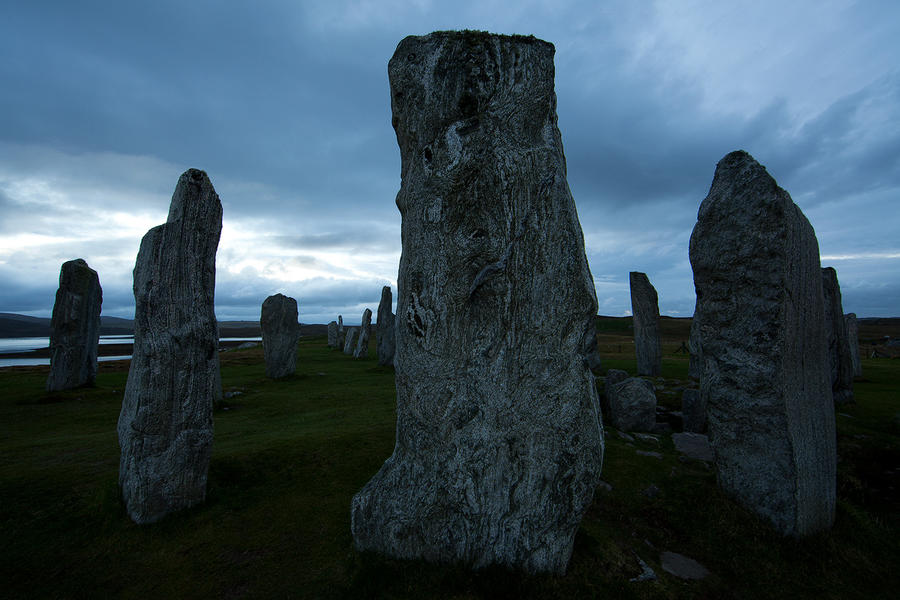
Standing Stones of Leth:
source

The stones are scattered throughout the Lowlands.  Their original masons and erectors are a mystery, and the stones themselves are not native to the country, appearing to have been transported a great distance.  Scarred and exfoliated by lightning strikes, these stones glow pale blue under a full moon.

In spite of their allochthonous and mysterious origin, several settlements have grown up around the stones in the belief that they provide some sort of protection or good fortune.  Indeed, gardens and orchards appear to grow more verdantly in the vicinity of these stones.

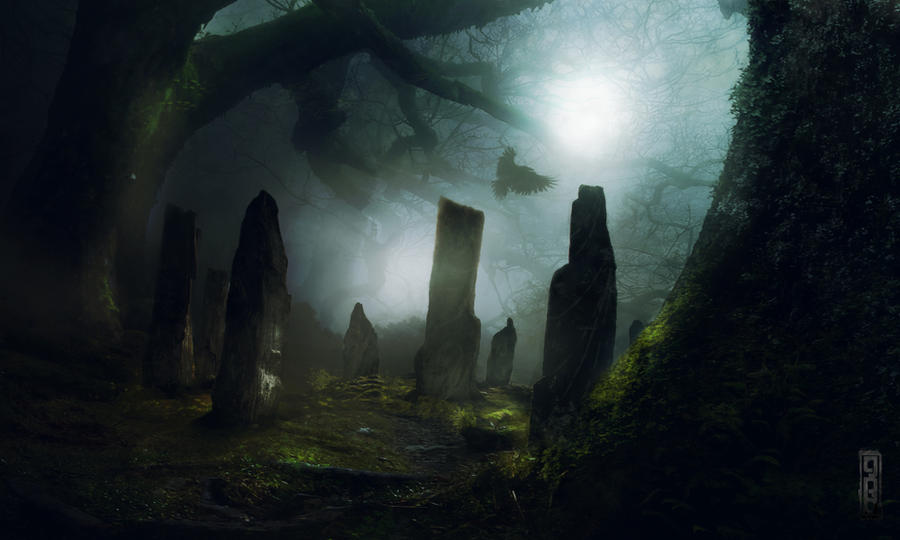
The stones were placed for more alien reasons, to allow entry into this world by ephemeral shades. Lightning strikes upon the stones provide enough impetus to temporarily open a gateway to a dimension of incorporeal beings, the Shades of Leth. During a storm, 1d6 shades will pass through these temporary gates into our world.
source
However, a Shade of Leth can not survive in this plane for more than four hours without finding a 'vessel' - an intelligent host. The shades will take advantage of the surrounding village or thorpe and possess the first humans they encounter.

A possessed human will have the blue glow of the stones in their eyes.  A captured vessel is 'ridden' by the shade in its inscrutable mission.  Anyone possessed in such a way will likely be exhausted and spent by a shade, requiring replacement every three to five days, wracked by dehydration and shock. An abandoned body, if still alive, will be mindless and hopeless for revivification.

Shade of Leth: 5HD, AC0 (AC2 if possessing human), Atk: 1d6+1, touch, (save or 1 CON loss, permanent), not undead, incorporeal resistances (resistances transfer to the possessed body), destroying the shade also kills the host body. Save vs death (or equivalent) is required to avoid possession (CON bonuses apply). A shade loses 1HD per hour outside of a host, dissipating after four hours.

The shades, once crossed over into this world, attempt to convene upon a central location in the Lowlands - a massive, buried hearth stone of the same composition as the standing stones.  When sufficient shades have arrived, the stone will arise, allowing not only shades, but their home dimension to spill through, wracking the world in unreality and making it a hospitable colony for the shades.

So far, insufficient simultaneous lightning strikes have occurred to allow a critical mass of shades through to activate the core stone.  However, there is rumor of misled or manipulated apocalypse cults intending to artificially create simultaneous lighting storms in the stones' vicinity...

source


Sunday, September 20, 2015

RPG Blog Carnival, September 2015 - Curses!!!

Johnn over at Roleplayingtips is hosting this month's Blog Carnival - Cursed Items and Calamities!


So, back in July, the Carnival topic was 'Legendary Weapons' - where a weapon became embued with its qualities, not necessarily from direct enchantment, but through energies gained from accumulated adventures and events.

So - conversely - why can't an object become cursed - simply because it's put together wrong, constructed with bad intent, or is involved in numerous unfortunate campaigns or events?

Case in point, my wife's car.

She owns a 2001 Subaru Forester- a 'gift' from her mother (warning #1). The car, purchased new, had come from the factory with a bad engine block (warning #2).  My brother-in-law, a Subaru mechanic, told my mother-in-law to have the dealer replace the car, which she was within her rights to request, based on recalls, etc.  She chose not to, but had the engine replaced (warning #3).  Several months later, she was t-boned at an intersection (warning #4).  And, again, went cheap on the repairs, counter to my brother-in-law's advice (warning #5).

At this point, she gets a new car, and gives the Subaru to my wife....

Saturday, July 18, 2015

Legendary weapons - July 2015 RPG Blog Carnival


Scott at Of Dice and Dragons is hosting this month's RPG Blog Carnival, with the subject of 'Legendary Weapons.'

Initially, I reblogged an old post on "Catholic +1 swords" - several historic or semihistoric weapons of kings and warriors that are hallowed relics for their association with alleged deeds. However, I also wanted to contribute something original, so will now commence to wandering about in another thought experiment....

Serendipitously, Talysman recently also discussed the creation of legendary weapons. These are not weapons enchanted by arcane or divine magics, but by powers gained through great, or perhaps infamous, deeds. He outlined a few criteria for the weapons, both mundane and esoteric, to make the weapon grow in power and capability as it was wielded.

Thought experiment time - three fates of the same weapon as it absorbs powers en route to becoming legendary...

Our weapon - a simple, but well-crafted, longsword, its grip wrapped in pebbly ostrich hide, a massive gold nugget capping the pommel, adding value, the dense metal giving the sword a well-balanced heft.

Tuesday, June 23, 2015

RPG Blog Carnival, June 2015 - "Summerland"

Happy summer solstice (slightly tardy, I know).

Phil at Tales of a GM has been kind enough to host this month's RPG Blog Carnival, and offered up 'Summerland' as a theme, whether imagining a Plane of Summer, activities of the season, festivals, or the solstice.


I didn't really plan to do an entry, but as the sun goes down at 9:15 PM here in the Northwest, strangely enough, I ponder that the days are cycling shorter once again, to those eventual dark days of winter....

And perhaps brief meditation on a population who may not welcome the long days....

Vampires and other denizens of the night gather to celebrate the shortest night of the year - the so-called Night of Hunger, where few emerge to feed, especially in the Northlands, where the nights are a mere pause between the crushing long days...

As the sun finally falls on the solstice, the night-walkers emerge, furtively, to gather at certain places of dark power. Carrying valuable vials of clerics' blood and other desecrated holy relics, they gather around black flames, feeding their offerings to the night, so that it may, once again, grow stronger, giving them the time and strength to prey on those weaklings who need the light...

source

The ceremony is brief, by necessity, for the burning light will return soon.  Best not tarry long...

Saturday, January 31, 2015

How and Where I Write - February 2015 RPG Blog Carnival

As the one-year anniversary of my return to creative writing and tentative foray into blogging approaches, I offered to host this month's Blog Carnival: How and Where I Write and/or Game Prep. 

Thanks to Johnn Four for helming this project.


Years ago, I tried to be a Writer, without much success. I wrote some short stories and essays, even getting a few published. I think my crowning achievement was winning the Romance category in the Bulwer-Lytton Fiction Contest, in spite of the fact that I have never read a romance novel in my life. But apparently I was adept at writing poorly on purpose. So there's that.

A bit over a year ago, I rediscovered gaming and the vigorous online DIY community of creators and theorists.  At about that time I also made the decision to be less of a consumer of content, and contribute a bit of my own, whether a story, a map, or a bit of treasure. So I've played around with mini-dungeon scenarios, occasional flash fiction, some essays on gaming environment, and a bit of crowdsource content.

For the next year, upcoming goals include another One Page Dungeon entry, a longer module-length piece, a new character class, short stories, and whatever crowdsource and/or contest content that doesn't have too strict of a dress code...

----
Like most creative folk, every writer has their own approach and opinions on the craft.

Among my writing books, I have two writers-on-writing books "Just Open a Vein," by William Brohaugh, and "On Being a Writer," by Bill Strickland. For the 30 or so essays/interviews in each book, there are approximately 30 opinions on 'how to write.' But they give a glimpse into each writer's method and philosophy, and there are many approaches. The creative process is as unique as the writer and their stories.

And each writer has their space: some spare, some well ordered, some cluttered.  Perhaps those spaces represent, or contrast with, the mind of the person sitting at their notebook or keyboard.

A few are documented in photo-essays like these:

http://booktique.weebly.com/blog/the-writing-space-of-famous-writers

http://www.whereiwrite.org/

I've always found this picture of Samuel Delany to be inspiring

So, here's a bit of me and my process:

I don't have a particular 'space' - sometimes it's at the kitchen table, sometimes at the couch. Regardless, I hew out a comfy space to put the feet up and an appropriate beverage to quiet the Internal Critic, or commune with the muse... Your call.


And I grab some inspiration, whether is it a writing cue, a piece of art, or a map.

Mix well with:

And add a soundtrack of something drony or ambient via http://somafm.com/. Or if I'm in an industrial mood: http://www.digitalgunfire.com/. Or if it's Sunday night, http://www.ontheedgeradio.com/ (via the local high school radio station, one of only a few left nationwide) (where the kidlet takes her broadcasting class and internship) (The old man became slightly less uncool when he revealed his punk and industrial leanings) (Who says kids and their folks can't share musical tastes?) (Ok, I'll stop with the parentheses now).

And often with the "help" of Ella (aka Snotcat), the typical aloof cat who suddenly requires one's attention when one is busy.


There are a lot of creative folks out there in Blogistan - some write for work, many more as a past-time. Likewise, we plan for games - perhaps reskinning, melding, or pulling critters and spaces and situations out of our own minds. And everyone has their own inspiration, process and space.

Feel free to share yours. Perhaps we'll all find a bit of inspiration.

Update: Wrap-up and commentary here.

Thursday, November 20, 2014

A New Race - November 2014 RPG Blog Carnival


Johnn Four took the helm of this month's RPG Blog Carnival with the topic of races.  How are they played? What flavor makes PCs or NPCs of a particular race special, and not just a batch of modifiers?

I think that many of us have doodled with races, either making our own, or modding up canon races.

Even in my brief ruminations, I have a bunch of elves who are nowhere near trees. My lizard-folk are an ancient and perhaps degraded race, seeking renaissance. And I cobbled together a quick mechanism for making any critter an intelligent 'uplifted' class.

*****

So, something new... among the classic creatures of myth (and gaming) are the centaurs.

Might they have a smaller, more canine, cousin?

Centdogs, dogtaurs?

How about Canivirum?

close, but not sure why the artist didn't commit to canine hind legs.

With the upper body of a humanoid and the legs and body of a dog, this liminal creature runs in loose packs in deciduous forest and plains climates. Much smaller than the familiar centaurs, the canivirum have been likened to a halfling-dog melding (much to their disdain). Semi-nomadic, their tribes/packs live by hunting and herding.  They have few industries of their own, but maintain a trade in wool and hides.  They live for the hunt, and love nothing more than a good challenge. To this end, individuals or parties requiring more exotic hides or meats have been known to offer a group of canivirum but a modest bounty to bring back the required beast (or its component parts).

Racial prerequisites: Con 12/Dex 9
Maximum Level: 8th; Level progression and saving throws as per Ranger, with subclasses, as described below
HP/Hit Dice: 1d8
AC: 8/12: any armor allowed, but costs 2X normal for customization. Shields as normal.
Weapons: no polearms or longbows; racial proficiency is with a short, thrusting spear (similar to Zulu assegai) and sling (+1 to hit/damage for both)
Movement: 15
AL: neutral or lawful
Languages: Racial + 1
Special: Pack Attack - when two or more canivirum attack a foe in concert, each receives +1 to hit as they circle and dodge their way through a target's defenses.  Likewise, the foe takes a -1 penalty to hit from the coordinated actions of the canivirum.  See also sub-types, below:

The canivirum generally tend to one of three sub-types.

Herder - Herders hold a natural influence over herd animals. They may tend semi-feral sheep and goats or work in concert with hunters, below, to corner or drive large prey herbivores.  Herders with Wis scores of 13+ may, at 3rd level, access cleric spells in the following progression:
Spell Level/
PC Level
I
II
III
IV
3
1


4
2


5
2
1


6
2
2


7
2
2
1

8
2
2
2
1
Hunters - The seekers and providers of the pack, hunters have increased tracking ability by sight and smell, as ranger, but beginning at 95% proficiency. They also receive an addition +1 to-hit for missile weapons (additive for slings, above).

Guards - Larger stalwarts watching over the pack, with +1 damage in melee or unarmed combat, gaining an additional +1 per two levels. Their natural wariness makes them unlikely to be surprised (1 in 6 chance).

---

As "wandering monsters" or an NPC group, canivirum may be encountered in herding/hunting packs of 2d4+2, with one 'Alpha' leader of one to three levels higher than the remaining pack members. Pack-groups may be exclusive (2/3 chance), or a combination of sub-types (1/3 chance):

Alternatively, nomadic parties will be encountered in family-tribal packs of 12-20 individuals, with males and females sharing hauling duties of travois containing belongings and portable shelters.

(I must attribute this creative exercise to my wife, who came up with 'dogtaurs' during a stream-of-consciousness moment - as I have mentioned before - I do not understand the workings of her mind....)

Tuesday, October 28, 2014

Parasite zombies (October 2014 RPG Blog Carnival)

I realized that I overlooked making my "Things that go bump in the night' entry for this month's Blog Carnival.  I had my wife sketch up a critter and everything!  Oh well, here's another extrapolated real-world nasty for your gaming environment...


There are several varieties of parasites that, as part of their life cycle, 'zombify' or mind-control their hosts in order to procreate.  The typical strategy is to cause the host to lose inhibitions or self-preservation, and therefore expose itself to predation or other harm in order to distribute larva or advance its life cycle. The Cordyceps fungus takes over ants and spiders, the Horsehair worms take over crickets, the broodsac flatworm controls snails.  All lovely lifeforms that are cause for plenty of skin-crawling.

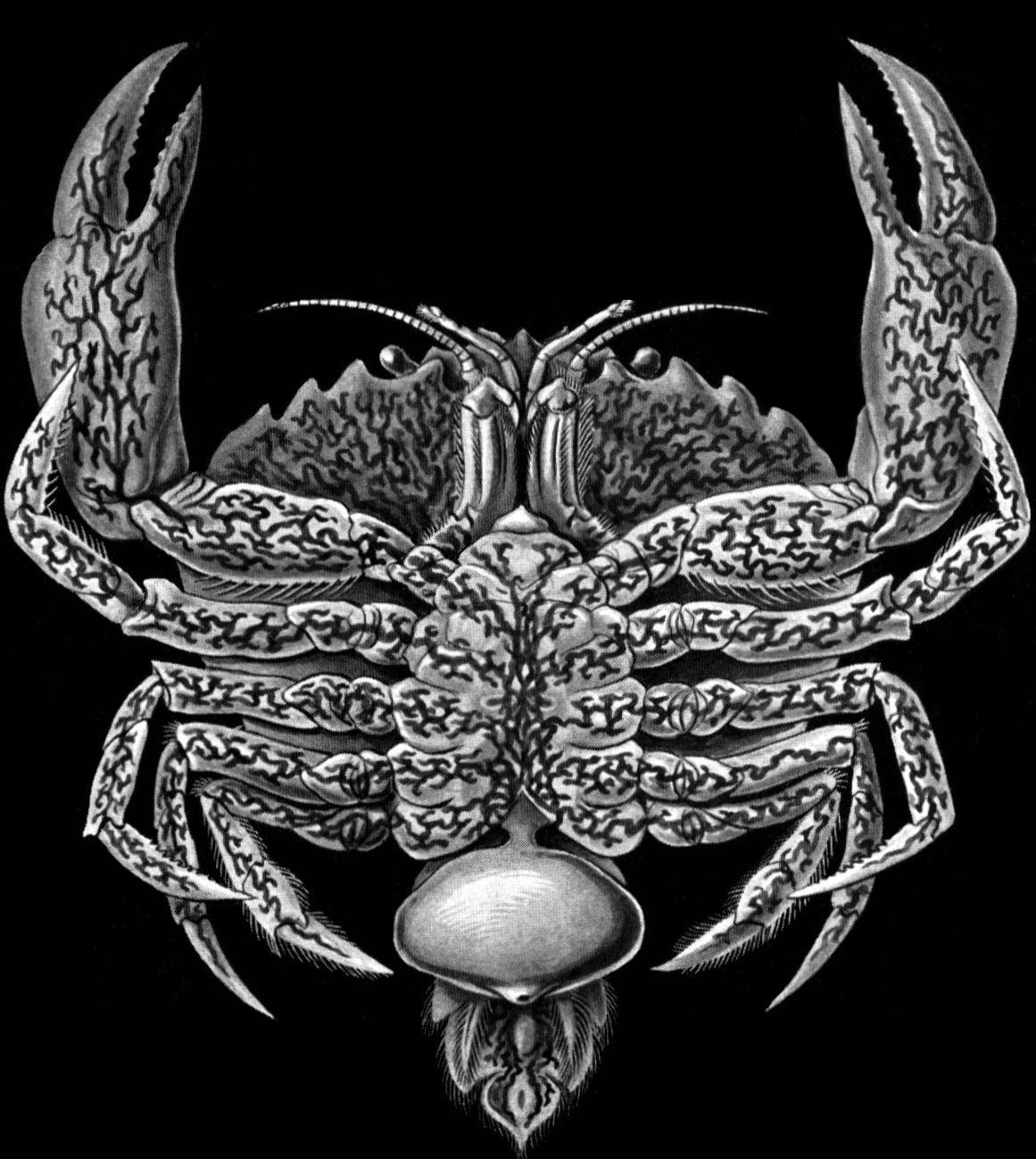
Although known since the late 19th and early 20th Centuries, the Rhizocephala parasitic barnacle popped up on several nature blogs last year, probably due to a lull in people finding things to cringe at on the Internet.

Illustration by the incomparable Ernst Haekel

Briefly, the Rhizocepahla is a parasitic barnacle that has shed its shell, appendages, and most organs in order to become, essentially, a swimming set of gonads and a nervous system. Which it attaches to, and infiltrates, a crab host, co-opting its digestive and nervous system.  Oh yeah, and reproductive system, making the host a brainless walking reproductive organ...

And so, I'll make it a game critter...