Saturday, February 28, 2015

February, 2015 RPG Blog Carnival Wrap-up

Taking a break from alphabetical dungeon dressings to wrap up this month's Blog Carnival, "How and Where I Write"

I received entries from eight individual bloggers, and Lowell Francis and Terl Ober both contributed multiple entries. Thanks to all for sharing - I really appreciate the responses.

First of all, a common theme seemed to run through most of the entries was not so much 'how' people write, but 'when.'  It's most illustrative of many of our middle-aged lives, full of work, family, other pursuits, and annoying cats.  I've read in other writing essays and guides of the importance of finding time "In-between."  In-between job tasks, picking up the kids, while waiting for the bus, etc. The difference in attitude of, "I only have 15 minutes..." and "I have 15 minutes!"

Terl Ober, I think, wins the dubious prize for this, with work, graduate classes, and seven kids... His goal? 15 minutes a day. But his second entry demonstrates his drive and creative use of time in finding that precious time, even writing while at the treadmill. Hats off to you, man, and thanks for the 30 minutes...

James Introcaso also writes during his available time wedged in between work, podcasting, freelancing, relationship, exercise, etc.  His writing gets pounded out during commutes, lunch breaks, etc. He calls it writing on a schedule, but perhaps more accurately - writing within a schedule. He also gets points for an affinity for the Mighty Mighty Bosstones.

Phill Nicols also writes among the responsibilities of fatherhood and how his writing schedule, too, is shaped by the schedules of school and holidays.  He also makes a personal schedule for his writing days, to stay on task, and to track progress on projects.

Mark at Creative Mountain Games is more succinct on his process in finding that time and space to write. WRITE EVERYWHERE! The tools are there, be it a notebook, a smartphone, or a computer.  We are no longer ever more than a arm's-length away from a way to record that idea.

Speaking of which, General Tangent talked about the evolution of the tools throughout his writing life - notepads, typewriters, old word processors, mini-cassette recorders.  Because there is nothing worse than getting an idea, and not having a method to get it recorded some way, lest it wanders off among all the other thoughts of the day.

Samuel Van Der Wall also shared a bit of his personal writing and blogging history. Within his story he made a note of his projects status: "Completed, In Progress, and Shelved." Shelved - ideas are saved, not quite in progress, or gelled, even, but not discarded, for they may be of later use.

Both Terl (above) and Phill Nichols emphasized the importance of outlining for their writing projects. Phill goes on to break down his outline and revision process for different writing needs - blogging, short fiction, and gaming prep.

Book Scorpion talked of game prepping - mostly with the mindset of having names and places in mind to allow freedom and consistency while improv-ing through a game.  And, most importantly, having a second set of eye/ears to bounce ideas off as she thinks of plots, transitions and hooks.

And the research prize goes to Lowell Francis, for putting together two surveys to get a better understanding on the time and  priorities of game prep among his readers.  The first focused on session prep, and the second expanded into campaign prep. He received about 400 responses between the two surveys, and they are illustrative of the effort people put into their preparations.

Thanks also to Johnn Four at Roleplayingtips.com for taking over the carnival a few months back.

And step on over to visit Mark at Creative Mountain Games to talk about the March theme, "Best GM Ever!"

And if anyone is curious, here's how I wrote this post:
Max says, 'Hi."

Friday, February 27, 2015

For the gamer who has everything...

Depleted uranium dice.

Bringing a whole new meaning to critical rolls.


Myconid colony

M: Myconids shamble among the luminous fungus of their lair.


Myconid colony (ganked the OG Dungeons of the Slave Lords mushroom-men) inhabits a hive-like series of caverns deep in the dungeon complex.  Reclusive and contemplative, they distrust outsiders, avoiding them and considering them to be disruptive, if not downright destructive. There will be 25 individuals present - 5 'circles' with one each of 1 to 5 HD, plus a 'Sovereign' (6HD). If the leader is killed or dies, the strongest of the 5HD fungus-men will replace it.

In addition to their native spore-generating powers, these myconids recruit mycelium to communicate and amplify their powers. 2-5 fungoids will touch and meld via the mycelium fibers over a period of 10 rounds (1 minute).  The group's composite HD will allow them to release higher-level spores (up to 5HD equivalent), and penalize saves by 1 point for each fungoid in the collective.
slimy

The entrance is 'guarded' by pet slime-molds - the slimes are attuned to the myconids,and will not attack them.  Intruders will be attacked be slimes dropping upon them (2 brown slimes, HD 2+1, AC 9, Move 0 (drops), attack clings to victim and turns to slime in 1d4 rounds, immunities: acid/electricity, 1/2 damage from fire).  There will also be 2d4 fungal zombies of 1/2 to 2 HD in the colony at any time.

The walls of the colony are luminescent with fungus, and the colony has several chambers.  The 'circles' inhabit the outer chambers, and the central chambers are used for their fungus garden. Many varieties are grown here, most benign, some beneficial, some hazardous:

a) Purple gnome-cap – Highly poisonous (Save or die if ingested). Dried and powdered gnome-cap is used by discerning poisoners;
b) Red Antler – strong hallucinogen lasting 1d4 turns, Save or: 1-2 - catatonic, 3-6 - helpless giggling, 7-9 - violent rage, 10-11 - blinded (1 day), 12 – prescient vision (1-3 days in future);
c) Yellow-ribbed morel – Delicious, nutty flavor, and high in calories. Nicknamed 'cave-pemmican';
d) Stinky pixie-seat – Odorous shelf fungus. Save or nausea 1d4 turns;
e) Blackcap – black, withered mushroom. Cures 1d6 HP upon ingestion;
f) Orc-dong – purplish-green, quite phallic. Fresh and dried specimens bring high prices among epicures.
g) Braveheart toadstool - +2 morale, dying blow – 1 final attack roll upon reaching 0 HP, regardless of turn.
(borrowed these from my myconid colony: Variation 1, here)

The Sovereign lives alone in the smallest chamber.  There will be 1d4+1 potions available at any time (pick 1st-3rd level magic-user potions and/or 1st-2nd level divine potions).

The mushroom-men are not interested in trade, but may parlay a few mushrooms or potions to an appropriately amiable individual or group. They are more likely to retreat and rely on their slimes and zombies to keep intruders at bay.

(I get more use out of Richard LeBlanc's Blob Generator.  If you have a chance, purchase his D30 Sandbox Companion and/or D30 DM Companion - HERE. You will not be disappointed.)

Thursday, February 26, 2015

Lost Tomes 3

L is for Lost Tomes (previously here, and here)

5 more books quickly ginned up to keep the Alphabet Dungeon stocked:
source
Lebelia's Bestiary.
Written in High Elf, this book describe various small to medium monsters and animals, with intricately-drawn figures of the creatures in question. Most pages are missing, apparent torn free.
Each remaining page, if torn out, burned and spoken over with correct incanation, will release the depicted monster (or monsters) up to 3 HD as per summon monster, except the spell duration is twice as long.  There will be 2d10 pages remaining, with random creatures pictured.

source
Chionld's Codex of Rejuvenated Lands:
Crafted by a druid committed to rehabilitating dead lands, this book, bound in dark brown bark, smells of earth and cut grass.  The book contains powerful ritual magics for the restoration of blighted or cursed lands to fruitfulness. Only readable by high-level druids conversant in the Old Tongue.

source
Lotus-Warrior Scroll:
Written in a foreign calligraphy, the scroll depicts a running creature trailing leaf-like feathers.  The scroll is 'planted' in the ground, anointed with 4 hp of blood, and the chant written on the scroll is repeated three times.  The ritual will call a Lotus-warrior from its plane of training and contemplation. The plant-based humanoid resembles a weasel coated in a close 'fur' of leaves. This magical creature bounds and tumbles from its home plane, and joyously announces its intent to serve its summoner in the pursuit of good and beauty. When faced with an enemy, the Lotus-warrior gambols and tumbles, striking and tripping with its whip-like head-leaf and stabbing with its lance-like wooden sword.  At the end of a day, the warrior will take a deep bow, and disappear in a flash of green.  An art object or valuable gem in possession of the party will disappear with it.
Lotus-warrior - 3HD, AC 4/16 (dodging and tumbling), Atk: (2) 1d6 (Head-leaf ) and 1d8 (lance). Special: 15' reach with head-leaf, target makes DEX save on successful hit or tripped. Warrior may strike creatures immune to normal weapons. May cast Protection from Evil once per day.


The Summoner's Gag:
This scroll appears to contain one to three offensive or attack spells (e.g. magic missile, web, lightning, etc.) However, if the caster reads from it, hidden glyphs become visible, animating the scroll, and gagging and suffocating the user, rendering them helpless (typically at the worst possible moment in melee). The scroll will deal 1d4 points choking and pummeling damage per round for 1d4+1 rounds. During this time, the spellcaster will be unable to speak or defend themselves against attack. The scroll may be burned to free the caster, but they will take half damage from the fire.

source
The Inquisitor's Scrollcase:
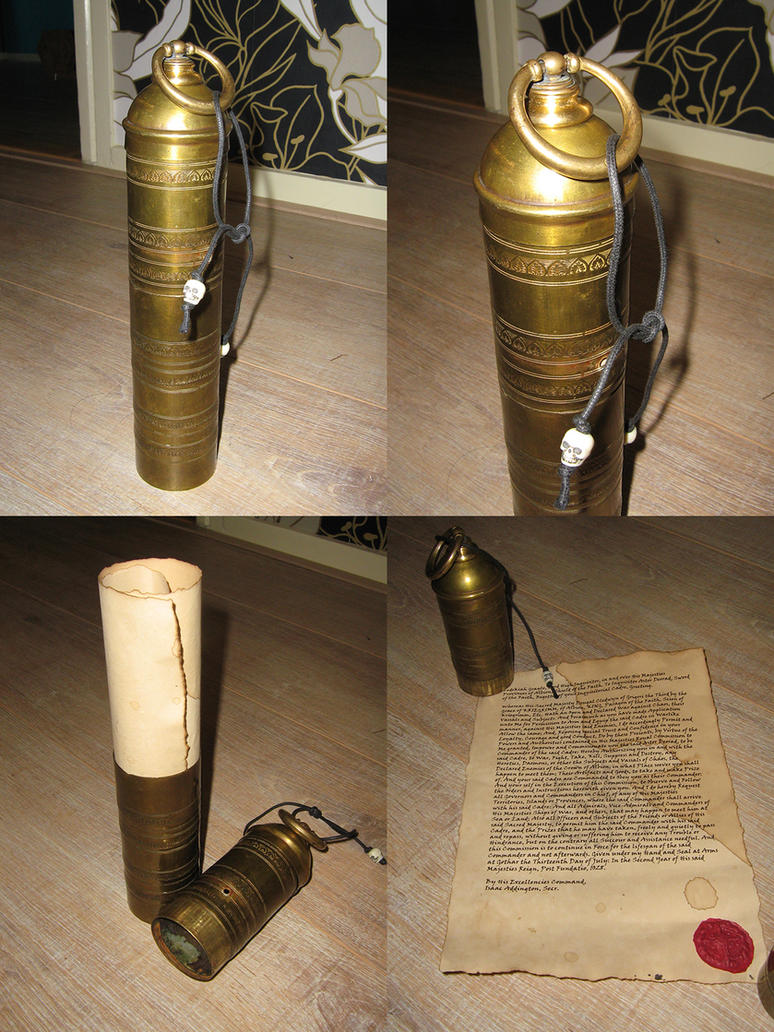
This relic, created by the Grand Inquisitor Tamrad three generations ago, amplifies mental control spells on scrolls stored within (e.g. charm).  Saves against spells stored in the scroll case are made at -2.  Additionally, the scroll case, if touched to an 'interviewee' will compel them to answer three questions to the best of their ability.

Wednesday, February 25, 2015

Necropolis

N is for Necropolis:

The necropolis stretches off into the dark. The repository of the dead consists of five rectangular chambers supported by massive stone columns.  Torches and glow-stones cast with continual light illuminate the expanse.  The area is musty with the dead.

Long ago established as hallowed, neutral ground by various groups and factions in dungeon, it holds the dead of conflicts and the hard life of the underground.

halls of the dead
The dead are arrayed according to the respective species and/or beliefs. Bodies here may be buried, mummified, stored in coffins or sarcophagi, stacked in ossuaries, stored in reliquaries or urns, etc. Guard-priests of various races take turns protecting the area from scavengers, both humanoid and animal.  At any time, there will be 6-12 humanoid guards patrolling the area in reverent pairs, silently keeping watch over the fallen.  If raiders appear, the majority will respond, with 2-4 scattering to raise alarm and reinforcements from nearby humanoid populations.  Anyone attacking or scavenging in the area will encourage an retribution attack of temporarily-allied races.