Wednesday, May 29, 2019

Mini-Review: The Year 1000

A couple months back, Colin Green mentioned picking up some new reading material of history for adding flavor and verisimilitude to one of his campaigns.

I recommended The Year 1000: What Life Was Like at the Turn of the First Millennium, An Englishman's World.

It had been several years since I read the book, so I took a quick burn through to remember its high points.

So here we go ...

As I've groused about before - history is taught poorly, so finding a well-written, entertaining history book is of value. The Year 1000 definitely meets this criteria.

Like many histories, the challenge of the time period is the general lack of surviving documents - either from lack of initial documentation, preservation, or destruction by later regimes.  As the book denotes, the surviving direct documentation for the time period in England may fill a bankers' box.

The book itself is themed around the Julius Works Calendar, one of the few surviving written works of that time period, and describes passage of a year at the approximate turn of the millennia, near the end of the period of Anglo-Saxon rule in England.

Each chapter is inspired by the month's calendar page, and describes both common life and activities for the month, as well as a larger theme for overall English culture or leadership. And, as the book looks at the turn of the millennium, it also uses the calendar as a tool to illustrate the transitions that England underwent during that era, such as unifying from four kingdoms into one under a centralized monarchy, progressions of strong and weak leadership (Alfred the Great vs Aethelred the Unready), the conflict and partial rule by the Danes, and the impending succession conflict between Harold Godwinson, Harald Hardrada, and William of Normandy...

For instance, the July chapter begins with a description of the 'hungry gap,' the annual period between spring and the harvest of the first crops where food stores were exceedingly low, before segueing into a discussion of the evolution and spread of monastic worship and life in the latter part of the first millennia. The chapter then expands on the monarchy (under King Edgar) using the church to legitimize the rule, and the church's role as a repository and distributor of the written word.

Overall, the format make for a fun, easy read, with informative chapters that don't drag.  By combining common life and greater culture, the book builds a whole world, not simply a collection of dates and events.

And for the aforementioned gaming verisimilitude, the book provides much color for background as the players encounter or interact with both commoners and notables in their travels. The monthly format can provide fun "what's going on in the background" descriptions depending on local seasons and activities.  And, of course, the "real history" of invasions, bickering fiefdoms, successions, and growing and waning cultural influences may provide much grist for adventue or campaign seeds. 

Enjoy!


(I discovered thru Anchor/MeWe that at least three other people also bought or were considering the book, so I hope that they are enjoying it as well...)

Thursday, May 23, 2019

Mad March Map - "Town"

Mad March Map the 27th - "Town"

Another tiny scene...
SOURCE

Explorers find the neighborhood ruined by cataclysm. Disconcerting energies cause their normally stalwart wardog to whimper. A metallic smell of dust and bones permeates everything.

For when wizards duel, the collateral damage lingers, even after these long years passed..

The district is characterized by blast craters, shattered, tottering walls, the remains of buildings barely standing...  The streets and shattered buildings echo with traces of majical fallout, and the place reeks of necromantic energies

Shuffling golems and zombies animate, the remnants and remains of the town's inhabitants, they still operate in a grotesque pantomime of their former lives, play-acting as shopkeepers, a smith at a cold forge, a skeletal maid sweeping before an empty, blasted inn.

No one in their right mind goes there anymore...

Sunday, May 19, 2019

Voices in the Chapel - revising an old map

Hi all - here's a brief setting built from an old Dungeon magazine map that popped up.  Set in a rural chapel, the locals are frightened by their local priests increasingly chaotic messages and behavior.


The map was found in Issue 2 of the magazine, as part of the 'Caermor' adventure published within.  The map itself is a simple, clean design, easily re-interpreted for a campaign location, such as this one.

So what is going on in Father Aldo's church?


Edit: quick revision to the thing in the cellar...

Tuesday, April 23, 2019

Torches and pitchforks

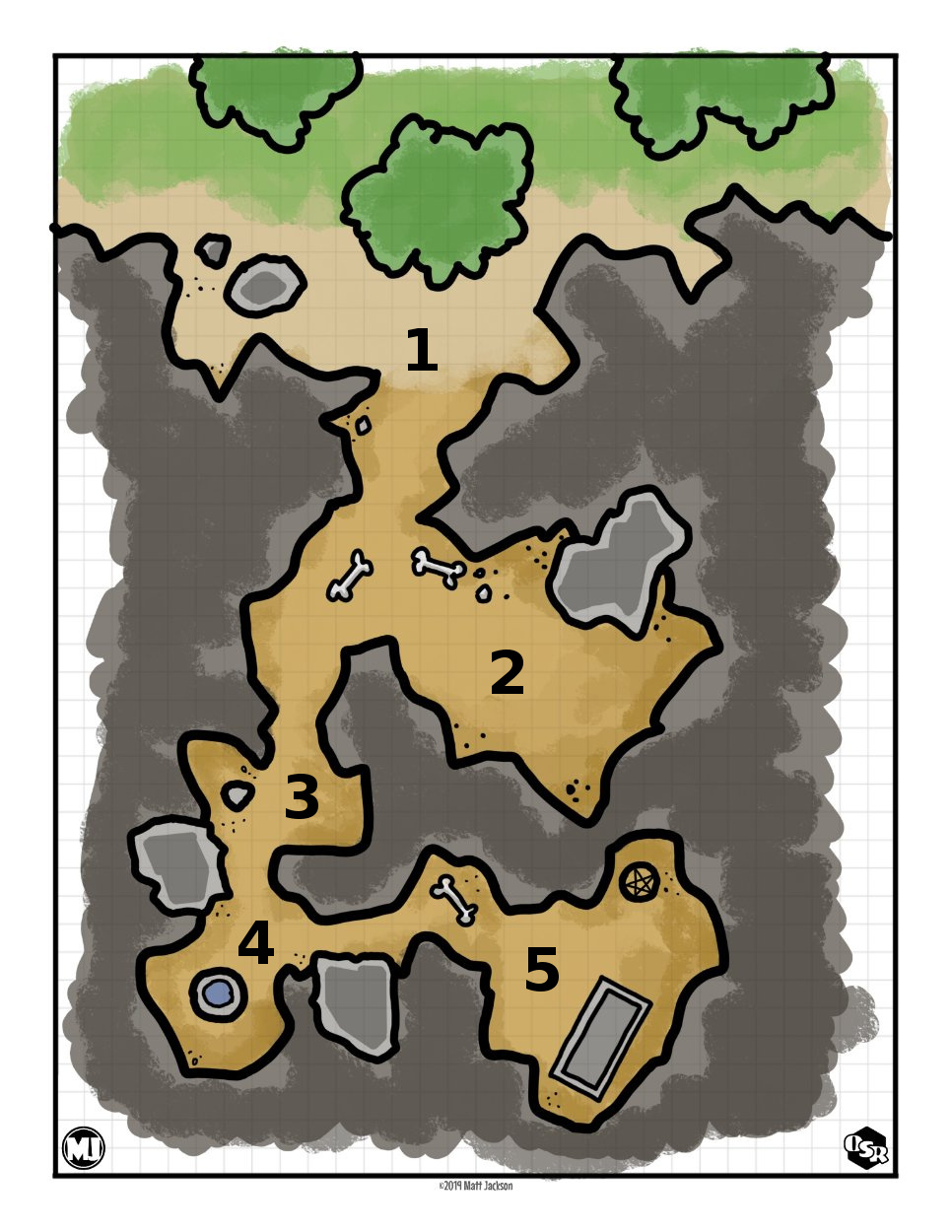
Blame Jackson for posting a quick map of a small tomb on Easter. That's my story, and I'm sticking with it.


A heretic was recently executed, their body placed within a tomb outside of town. As insurance against their meddlesome followers, the tomb entrance was barricaded and manned with guards to warn the curious away. This morning, the guards' replacements found the barricades dropped and the guards missing.

1. Tomb Entrance - Barricades placed across the opening have been removed/displaced. A smell of death, greater than what would be expected, permeates the area.

2. Signs of Death - Scattered bones are strewn on the floor. Remnants of armor and weaponry indicate that these were once the tomb guards, left to keep watch over the barrow. Secreted away under a boulder emerging from the north wall is an urn containing 190 gp and a few ambers (9, 10, and 20 gp).

3. Ghoul! - A ghoul has found its way into the tomb, and has been picking clean the bones of the dead guards. It will attack anyone investigating the tomb.

4. Pool! - A seep has created a pool in the center of the room. The water has absorbed some divine characteristics, and is the equivalent of holy water. It will cause damage (1d8) to the undead in Area 5. Drowning the being will prevent its regeneration. Remains of another unfortunate tomb guard are in the corridor to the tomb (+1 hammer, purse with 41 gp).

5. Heretic’s Tomb - The tomb houses a stone sarcophagus containing the restless remains of the martyred prophet - an undead still containing a ‘spark’ of life - unfamiliar necromantic energies have imbued the corpse with regenerative abilities, and it becomes "less dead" with each passing day.

Revenant: 5 HD; AC 4/15; Atk touch (1d6+ level drain); Effects: Undead resistances, may cast charm and fear once per day, level drain. Holy water, magic or magic weapons are required to hit and damage. Regenerates 1HP/round during combat. The 'Revenant' becomes more resistant to turning each day by 25%. Roll 1d3 for days "dead." After 4 or more days, the being is immune to cleric turning abilities.

The alter at the north side of the room is that of a protective god, placed as a ward against potential reanimations. The alter grants resistance against the Revenant's spell and level drain attacks to anyone within 5 feet.

Monday, April 15, 2019

Random Monster: Hippolyta's Hounds

Just attended A Midsummer's Night Dream ballet with the kidlet, had been a few years since I'd seen the performance.  As always, a visual and dance spectacle...

I had forgotten details of some of the scenes and set, and was quietly amused at some surprised audience gasps as a set piece representing a dew-covered spiderweb descended on-stage - complete with a spider that dwarfed the dancers (4HD, I estimated....).

And so gamable. Fey, drugs, love triangles...

Midway through the first act is a solo dance by Hippolyta, Queen of the Amazons.  In this production, she is accompanied by six 'hounds', who circle the stage around her, as if flushing prey.

There is a mere glimpse of the hounds at about 1:40:


Again, noticing details - the dancers ran with their arms stretched before them, the nearly-white dog-heads (below) contrasting with form-fitted reddish 'coats'...

Source
And all I could think was Undead....

www.deviantart.com/seriocomic

Hippolyta's Hounds

Undead hunting dogs bearing the souls of poachers, those who wasted their kills, and those who trespassed in the sacred groves. Captured and cursed by a goddess of the hunt, they live their afterlife in the bodies of decayed hunting hounds...

Bony skulls and bodies flayed of skin, baying in pain and anger, they pursue their own ghostly hunts or trespassers into the groves, as well as seek those next accursed souls.

HD 4; AC 6/13; Atk 1 bite (1d8)1d8 - save or the wound becomes necrotic and can only be healed by magic; Move 14; Save 12; AL N; CL/XP 5/240; No. appearing: 3-6; Special: The hounds' baying has the effect of a 'Scare' spell, -1 to saves for each additional dog in pack greater than three.

www.deviantart.com/nikkiburr