A recent study by a professor at Ithaca College found that very few libraries include RPG books and resources with in their collections.
Based on review of the Online Computer Library Center, a database of 72,000 libraries, very few libraries have even a single copy of an RPG book in circulation, in spite of the genre's 40+ year run.
Interestingly, there may be some data gaps, as the search was by ISBN numbers, which weren't assigned to early additions of TSR manuals, or their contemporary Runequest books.
The authors posit that inclusion of the manuals in the reference stacks have value for library -sponsored community gaming events (40% of liraries reportedly host gmae events of some type), as references for academic or similar study, such as their influence on the video gaming industry and game theory.
Anyway, an interesting read.
Link to download report
Thursday, September 24, 2015


Sunday, September 20, 2015
RPG Blog Carnival, September 2015 - Curses!!!
Johnn over at Roleplayingtips is hosting this month's Blog Carnival - Cursed Items and Calamities!

So, back in July, the Carnival topic was 'Legendary Weapons' - where a weapon became embued with its qualities, not necessarily from direct enchantment, but through energies gained from accumulated adventures and events.
So - conversely - why can't an object become cursed - simply because it's put together wrong, constructed with bad intent, or is involved in numerous unfortunate campaigns or events?
Case in point, my wife's car.
She owns a 2001 Subaru Forester- a 'gift' from her mother (warning #1). The car, purchased new, had come from the factory with a bad engine block (warning #2). My brother-in-law, a Subaru mechanic, told my mother-in-law to have the dealer replace the car, which she was within her rights to request, based on recalls, etc. She chose not to, but had the engine replaced (warning #3). Several months later, she was t-boned at an intersection (warning #4). And, again, went cheap on the repairs, counter to my brother-in-law's advice (warning #5).
At this point, she gets a new car, and gives the Subaru to my wife....

So, back in July, the Carnival topic was 'Legendary Weapons' - where a weapon became embued with its qualities, not necessarily from direct enchantment, but through energies gained from accumulated adventures and events.
So - conversely - why can't an object become cursed - simply because it's put together wrong, constructed with bad intent, or is involved in numerous unfortunate campaigns or events?
Case in point, my wife's car.
She owns a 2001 Subaru Forester- a 'gift' from her mother (warning #1). The car, purchased new, had come from the factory with a bad engine block (warning #2). My brother-in-law, a Subaru mechanic, told my mother-in-law to have the dealer replace the car, which she was within her rights to request, based on recalls, etc. She chose not to, but had the engine replaced (warning #3). Several months later, she was t-boned at an intersection (warning #4). And, again, went cheap on the repairs, counter to my brother-in-law's advice (warning #5).
At this point, she gets a new car, and gives the Subaru to my wife....
Tuesday, September 15, 2015
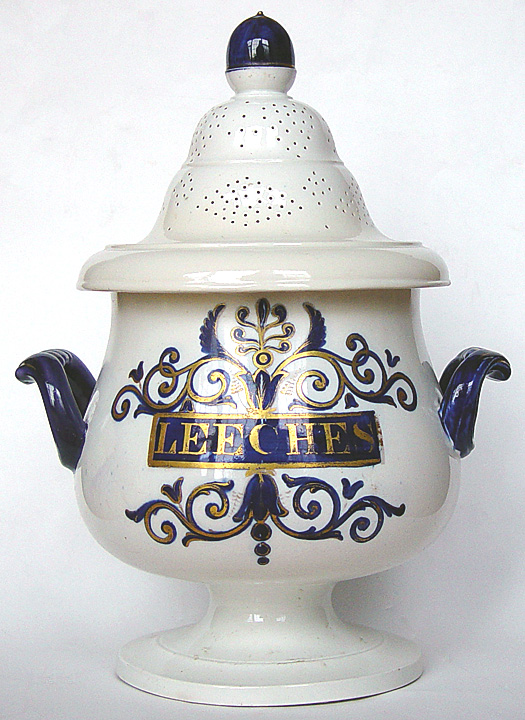
Random Magic Item: Hildegard's Jar of Leeches
 |
| source |
Appearing to be a common ceramic leech jar, this enchanted urn is found in the most discriminating apothecaries', barbers', and chirurgeons' establishments, lending enhanced or expanded recuperative abilities to the proprietor's skill sets.
The jar will contain 1d4 leeches. Application of one or more leeches will have the following effects, equivalent to the respective cleric spells:
One Leech:
Cure light wounds
Cure paralysis (2 required if paralysis is non-temporary)
Two Leeches:
Cure disease
Three Leeches
Cure serious wounds
Neutralize poison
Other beneficial effects include:
Three leeches cure mummy rot
Four leeches will restore permanently lost STR or CON due to magical or physical attack
Five leeches will restore one drained level
 |
| source |
 |
| source |
Saturday, September 5, 2015
Monster: Eurypterid, Feersum

The recent discovery of a new species of 'sea scorpion,' or eurypterid, pushes evolution of the the Paleozoic predator back approximately 10 million years. The new genus was named Pentecopterus, after the penteconter, an early Greek galley. Although these particular fossil individuals were approximately six feet in length, specimens of over eight feet long have been found.
The eurypterid was not a scorpion, but an arthropod more closely related to modern spiders, lobsters, and ticks. The 'sea scorpion' nomenclature come from the spiked tail in some genus', however they have not been found to be venomous, and likely preyed on trilobites and other creatures using modified forelegs and claws.
 |
| Source |

Monday, August 31, 2015
The Village of Croftsfford
The Village of Croftsfford sits on the east bank of the Tisov River. The town founders built on two low mounds above the floodplain, reinforcing their settlement with a pair of levees north and east of the settlement. Buildings not on the mounds tend to be built up on four to eight foot tall stilts. The village straddles the West Trade Road, and provides a brisk ferry service at a narrow spot in the river above a small rapid.
Travelers will spot the multi-colored roofs of the village's residences and shops at some distance. How a wilderness town came to be so gaily painted is open to some speculation, but the truth is that an over-weighted peddler's wagon toppled off the ferry several years back. The unfortunate peddler perished in the river, and the residents scavenged what they could, including many tins of pigment, which were mixed with tallow and re-purposed as paint.
The north levee and adjacent floodplain is lined with a rough palisade, with a watchtower overlooking the river. The defenses are primarily a deterrent to raids from troglodyte tribes upstream. The troglodyte raids are an attempt to dislodge the humans from the mounds, which are actually ancestral troglodyte burial tumuli raised above the surrounding floodplain.
Citizens of note:
Travelers will spot the multi-colored roofs of the village's residences and shops at some distance. How a wilderness town came to be so gaily painted is open to some speculation, but the truth is that an over-weighted peddler's wagon toppled off the ferry several years back. The unfortunate peddler perished in the river, and the residents scavenged what they could, including many tins of pigment, which were mixed with tallow and re-purposed as paint.
The north levee and adjacent floodplain is lined with a rough palisade, with a watchtower overlooking the river. The defenses are primarily a deterrent to raids from troglodyte tribes upstream. The troglodyte raids are an attempt to dislodge the humans from the mounds, which are actually ancestral troglodyte burial tumuli raised above the surrounding floodplain.
 |
| download map |
Citizens of note:
Subscribe to:
Posts (Atom)