Showing posts with label clerics. Show all posts

Sunday, June 1, 2025

May RPG Blog Carnival Late Entry: Oaths - The Beguine/Beghard Class for OSE and Shadowdark

Ok, here we are on May 32, and I'm right on time to contribute to the month's Blog Carnival. This time hosted by Tabletop Curiosity Cabinet and themed, "Oaths." So let me share a small introduction to a historic religious community, as well as a player class (OSE and Shadowdark) inspired by them:


The beguines (and their male counterparts, the beghards) were religious lay-communities most active during the 13th - 16th centuries. While not formally monastic in nature, the members typically took vows, most commonly chastity, as well as of charity and religious devotion. Members were also able to quit the role, and return to secular life. 

The communities were typically self-supporting, with their members taking part in cottage industries. These beguinages could be as small as a shared house up to a walled compound. Larger examples contained shops, hospitals, breweries, and cloth mills.

Because many of the beguines came from middle- or upper-class backgrounds, many were literate and wrote treatises and poetry reflecting their faith and the visions that they experienced during contemplation and prayer. This mysticism was a common theme among the communities, as well as the idea of sharing these "visions" through religious or secular texts. Because these publications were outside the orthodoxy and independent of Church doctrine, they were often criticized or suppressed, with the most egregious example being the burning at the stake of Marguerite Porete as a relapsed heretic by the Inquisition.

After all, there is nothing more frightening than a financially independent, literate woman interpreting religious dogma.

Thursday, October 7, 2021

A Pilgrimage to Aldo's Call

Not much to report - writing is off, been reworking a prior project to re-introduction into the outside world. Been getting outside and moving around...

So, this is Aldo's Call, named for a martyred priest whose death is memorialized beneath the dome of the local temple/shrine. Folks come from all around to visit the site, and the surrounding village is purposed to serve the temple and its many pilgrims. 

Visit the town! (download)

Crafted from another fine Jackson illustrated product. 

Saturday, September 19, 2020

The Gaol of Kilmanhard has some new tenants...

Shuffling around on my desk for a map that I swore I just printed out and this one surfaces instead. Like everything lately (gestures broadly), I don't remember where I found it or what inspired me at the moment.

Map in its original orientation

But statues, and a pool, and apparently a conference table. Important things are going down here. 

What exactly is going on in this secret place? Well, as my notes clearly show:  


...it is a hidden temple to a primordial god, one known for their two aspects, one of blessing and one of destruction.... 

Somewhere in the middle of this I figured out that it was a Jackson map from 2016, and that I had it oriented upside-down from the original presentation. So be it.

Ok, enough rambling and dawdling. Go see who has occupied the Gaol of Kilmanhard. And don't worry about pissing off old oceanic gods. After all, what could go wrong?

Original by Aurther Rackham

Ok, now I'm going to go print off that other map a 2nd time. Which probably means I'll find the original copy...

Tuesday, April 23, 2019

Torches and pitchforks

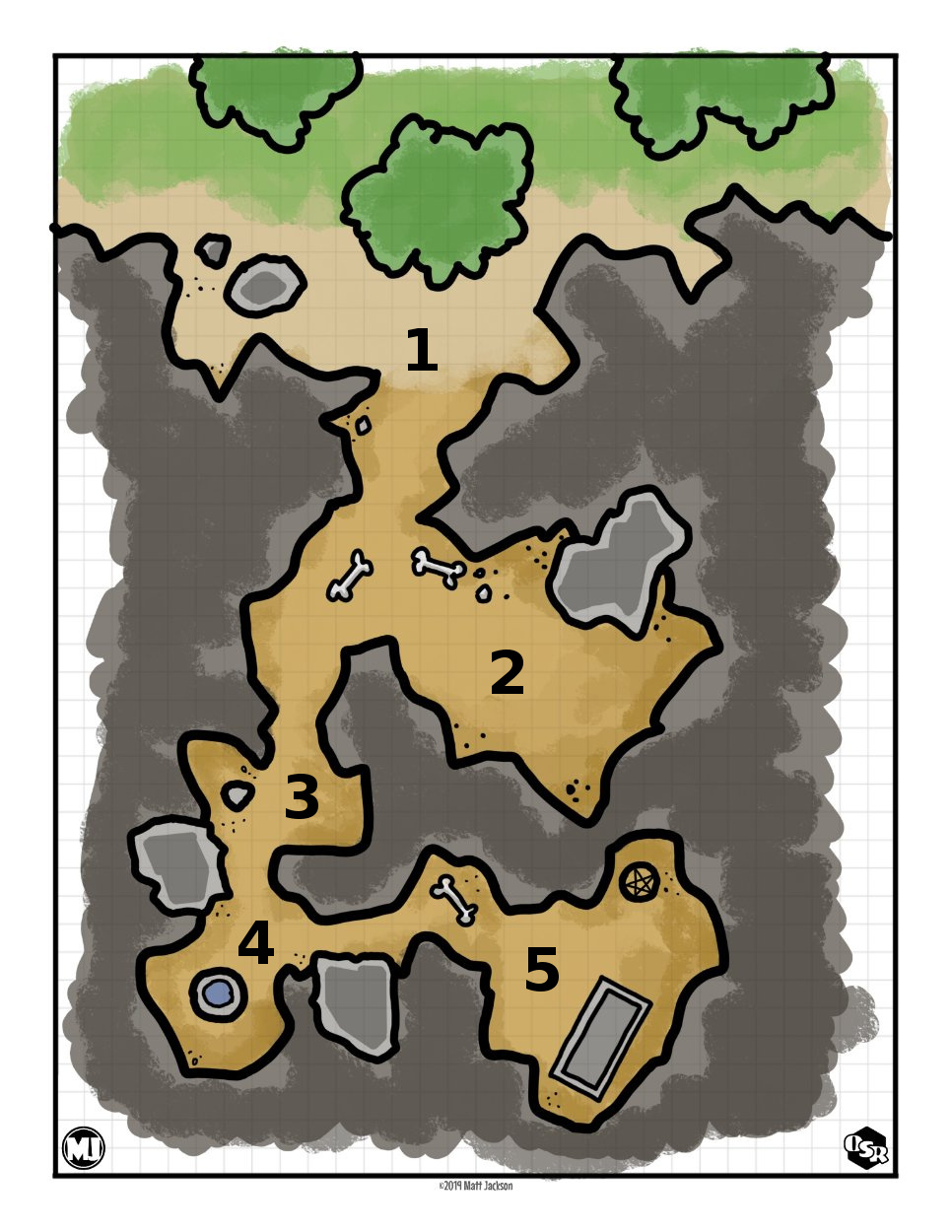
Blame Jackson for posting a quick map of a small tomb on Easter. That's my story, and I'm sticking with it.


A heretic was recently executed, their body placed within a tomb outside of town. As insurance against their meddlesome followers, the tomb entrance was barricaded and manned with guards to warn the curious away. This morning, the guards' replacements found the barricades dropped and the guards missing.

1. Tomb Entrance - Barricades placed across the opening have been removed/displaced. A smell of death, greater than what would be expected, permeates the area.

2. Signs of Death - Scattered bones are strewn on the floor. Remnants of armor and weaponry indicate that these were once the tomb guards, left to keep watch over the barrow. Secreted away under a boulder emerging from the north wall is an urn containing 190 gp and a few ambers (9, 10, and 20 gp).

3. Ghoul! - A ghoul has found its way into the tomb, and has been picking clean the bones of the dead guards. It will attack anyone investigating the tomb.

4. Pool! - A seep has created a pool in the center of the room. The water has absorbed some divine characteristics, and is the equivalent of holy water. It will cause damage (1d8) to the undead in Area 5. Drowning the being will prevent its regeneration. Remains of another unfortunate tomb guard are in the corridor to the tomb (+1 hammer, purse with 41 gp).

5. Heretic’s Tomb - The tomb houses a stone sarcophagus containing the restless remains of the martyred prophet - an undead still containing a ‘spark’ of life - unfamiliar necromantic energies have imbued the corpse with regenerative abilities, and it becomes "less dead" with each passing day.

Revenant: 5 HD; AC 4/15; Atk touch (1d6+ level drain); Effects: Undead resistances, may cast charm and fear once per day, level drain. Holy water, magic or magic weapons are required to hit and damage. Regenerates 1HP/round during combat. The 'Revenant' becomes more resistant to turning each day by 25%. Roll 1d3 for days "dead." After 4 or more days, the being is immune to cleric turning abilities.

The alter at the north side of the room is that of a protective god, placed as a ward against potential reanimations. The alter grants resistance against the Revenant's spell and level drain attacks to anyone within 5 feet.

Saturday, April 6, 2019

Vobleavira Complex, a B1-Inspired Crawl...

So, when Matt Jackson posted up 'Barrowmound #11'  on his Patreon, I commented, "Cool, looks like a mini Quesquaton. Now, where to put the room of pools...."

And that's how I committed myself (at least in my mind) to statting up this maze... The occupants of Quesquaton were Rogahn and Zelligar, a fighter and mage, respectively.  Considering this, the occupants of this maze must be the other two base B/X human classes - a cleric and thief...

With that meager concept, I was off...

So we have a cleric and thief who found themselves allied in adventures, found their own subterranean outpost, and created a space that reflects their two characters' personalities. While it isn't as extensive as B1, I hope that it has a similar flavor. The challenges and exploration, like B1, are put together with low-level mooks in mind. I even included a handful of B1-styled pregens in the back, complete with appropriately wacky names.

No room of pools though. Sorry about that...
GET IT HERE
Many thanks to Matt for the original map, converting me to the zine format, and several days of editing back and forth in Google Docs. And to my wife for drawing up a few creepy goblins :) Thanks also to Gavin Norman, for his B/X Essentials and general blessing of this crapshoot.

More to come...

EDIT: Download link updated to DrivethruRPG as PWYW
EDIT2: Adventure revised with additional encounters, language consistency fixes, and shuffling stuff around.

Sunday, March 24, 2019

The Plague Doctor Class for Old-School RPG Shenanigans

Time for another goofy character class, because I've been reading history, and why not?

The Plague Doctor!


Plague doctors 'treated' victims of the bubonic plague in medieval Europe. Well, treat may be a strong word - more like attempt ineffective cures, and mostly keep an accurate account of the dying.... They were hired by the cities and municipal authorities, and were charged to treat everyone, regardless of their station in life.


But there's that whole mask thing... The raven-like close-fitter mask with aromatic herbs filling the "beak." Believed to protect the wearer from bad humours, and airborne "miasma," the iconic mask did little more than subdue the smell of disease and death, and give its wearer their intimidating appearance.  Exposed to disease, famine, and other maladies, plague doctors succumbed to the disease at similar rates as their "patients."

So why would you want to play one of these medical quacks? Maybe you need to shill some snake oil, move with impunity through quarantines, or even effect a real cure now and then.  Whatever the case, strap on that mask, don your coat and hat, and go cure some plague!

DOWNLOAD

And, because I've been playing The Black Hack with Matt Jackson and few other miscreants - have a custom class for that grotty system (review upcoming!).

Now part of the Whack Hack collection of PC classes!
And here, have some Mono, Inc. to get you in the mood for rocking your bad Plague Doc self.


Edit: Per a couple of comments, this class could be folded into a low fantasy or 'no cleric' environment.  Using the OSR variant, perhaps lend them the healing kit from the BH version.  Or even play up the charlatan aspect, and let the player choose one thief skill. Have fun!

Edit 2: Black Hack version re-uploaded with latest version, consistent with thumbnail image.

Wednesday, July 26, 2017

So Your Cleric Pissed Off Their God…

Haven’t posted for a while, so here’s a list…

So your cleric, inadvertently or otherwise, betrayed their deity or violated their vows.  Maybe they offed some orc kids, huffed fungus-man spores, or hooked up with a half-elf of questionable mores…

Regardless, there they are, without spells or turning powers, and entreaties to their god are met with silence…

Better see what it’s gonna take to remedy this…
1. Shit-ton of cash (one level equivalent)
2. Scarification/branding/ordeal (visible scars, perhaps dismemberment)
3. Oh, you wanted to confess and gain forgiveness??  That’s not this temple – you have to go to the central/original/obscure temple (far away….)
4. Oh, sure, just go find this particular relic.  I think a dragon is using it as a pillow…
5. Fasting and penitence…
6. Naked and begging down on the corner
7. Commit a selfless act.  It had better be Medal of Honor-worthy.
8. Read a really big, obscure book of the religion.  Better yet, memorize it.
9. Go plant a tree.  In a sacred grove, it’s a rare specimen.  Watch it grow for a while.
10. Take on a “lost cause”
11. Preach and teach to others of the errors of your ways as an object lesson.
12. Sorry buddy.  Not happening.  You’re now a middling fighter with a mace and a holy symbol…

Ok, so you got your god to let you off the hook, but nothing comes without a cost:
1. You are reinstated, but at 1d3 levels below your original.
2. That port-wine stain marks you as having betrayed your vows.
3. Stigmata.  Preferably at awkward moments.
4. You are blinded to the spiritual world.  One eye goes cloudy, and you can no longer cast detection spells.
5. 1d3 point charisma loss and associated effects on followers and reactions.
6. Armor burns you!  Rely only on the protection of your god – unarmored…
7. Turn undead at 1d3 levels below your current level*
8. Variable effect spells cast at -1 (time, healing, number affected)*
9. Opponents save at +1 vs spells*
10. Loss of class-based saving throw bonuses*

* - lasts for a period of a year and one day.

Thursday, May 18, 2017

Divine scrolls - a consideration...

I've been pondering divine scrolls and their synthesis.  A common thread of the rulesets for scrolls is time plus a certain value of consumable components to create the scroll. Based on the trope of the arcane class, the scroll is created via research or transcriptions, and the material components are likely associated with spellcasting or using rare materials for ink/illuminations to bind the spell to the scroll.

However, cleric/divine spells are not traditionally held within a spellbook, but are granted via prayer or inspiration from the cleric's deity.  So how would a divine scroll be transcribed?  And how is the monetary equivalent used?

Is the material value may be spent in tithes or proper sacrifices to curry the deity's favors (e.g. the 'fatted calf')? That could work.  Or...

Source
Perhaps, since the cleric is the recipient or conduit for spells, then they may also act as the catalyst for scroll creation.  Therefore, that 'conduit' must be expanded to generate the energies necessary to transcribe divine forces onto a scroll.  And a common traditional method for a priest/shaman/cleric to get into strong and direct communion with the divine was through mind-altering substances.

So, like the above arcane components necessary to create a scroll, the cleric may require a rare drug (its quantity/value/rarity proportional to the level of the spell) to descend into a trance to best prepare themselves as the device through which the spell is communicated.  The spell is then transcribed via automatic writing or some similar trance-device.

Just came up with this while theorizing on what might inspire a cleric to be searching out loot or rare materials, which then descended into a thought-experiment of how were they going to transcribe those scrolls, anyway?  So feel free to take it or leave it...

"Yes, I'm Br'er Rombur of the Divine Zhiver.  I understand that you plan to delve the Caverns of Leromos.  I understand there are stands of a certain fungus found there that I use in my, umm, worship..."

Sunday, February 12, 2017

Magic Item: Saint Iriabel's Censer of Alliance


Tabletop Terrors is hosting this month's RPG Blog Carnival, with the theme of 'Rethinking Encounters': including rethinking encounter mechanics, making them memorable, redefining encounters, and creating items associated with encounters...

And I've found that if I don't take advantage of some inspiration as it strikes, it tends to dissipate into the aether.

So here ya go - 15 minutes of inspiration and Wikipedia....

Source

Saint Iriabel's Censer of Alliance

The Way-Priest Gegar Iriabel was a missionary-explorer to the Chaos-lands that encroached on (and periodically overran) the boundaries of the tamed lands.  Rather than simply smiting Chaos as he found it, he was known to proselytize to the 'Darkness' and occasionally found some success, as evidenced by his periodic entourage of hobgoblins and orcs.

For Iriabel found it much more profitable, and less hazardous, to create small alliances, or sway factions within Chaos forces to either support him, or at least allow him passage in his greater crusading goals.  These goals often included recovering hostages, retrieval of lost or stolen artifacts and relics, and re-sanctifying desecrated places along the edges of civilization.

In this pursuit, he fortified his own faith and powers of persuasion with a chain censer blessed to magnify the powers of a wandering priest in hostile lands, such as himself...

The Censer was made of silver worked with rare examples of lapis and topaz.  Swung by a short chain while burning certain blessed charcoals and incenses, the Censer creates the following effects for a Law-aligned cleric (or class allowed use of cleric magic items):

  • +2 on reaction rolls with potentially hostile or unknown parties.  Irabel blessed the device to have its greatest benefit when encountering an unknown individual or group in unfriendly territory.  While the Censer may not have the outward benefit of a charm spell, Irabel found that, along with his own powers of persuasion, such an amplifier was quite suitable to create voluntary temporary allies.
The Censer grants bonuses to the following common encounter-based spells
  • An additional +1 bonus to saves (and corollary -1 penalty to chaos forces) Protection from Evil, (For Protection from Evil, 10' Radius, the radius if doubled)
  • An additional +1 bonus for a character under the benefits of a Bless spell
  • An additional -1 penalty to creatures affected by a Prayer spell 
Other bunuses granted by the Censer include:
  • +1 on undead turning rolls
  • While the Censer is burning, any ally within 10 feet is protected from contracting disease due to its protective smoke and fumes. 

Bonuses will last while the Censer is burning,  The Censer will burn for 1d2+1 hours with each charge of charcoal and incense.

After Iriabel's death and canonization, the Censer was housed in his fortress-monastery in the northwest of the kingdom,  Ironically, the monastery was overrun by Chaos warbands a decade after his death, and the Censer itself was stolen away.  Perhaps a brave and clever party will seek to recover it...

Friday, March 20, 2015

Wermhalten

A small village centered around an ancient worm burrow, and adjacent to a trade road, Wermhalten has seen the recent arrival of a worm-cult priest and his followers, bringing both prosperity and conflict to the town.

download

Calcified 'God-worm' tunnels run throughout the vicinity of Wermhalten. The village is located within the largest concentration of surface representations of the tunnels, including a 'junction' in the center of town. The tunnels are prehistoric in origin and have been exposed where the land surface has become eroded away.

No tunnel entrances are exposed in town, but a few may be located elsewhere.  Most of the tunnels appear to be filled with sediment or calcareous worm-castings, but a few may still be accessible, if an entrance may be found, and enforcers of the local cult may be avoided. Tainted vegetation surrounds exposed worm burrows, and an observant explorer can see traces of twisted foliage where the burrows are near the surface.

Commerce and culture of the town has recently become centered on a worm cult and the pilgrims who arrive to worship.

Monday, February 23, 2015

The Ilanuran Ibis

I is for the Ilanuran Ibis:

"Kayl's dead, damn that wight. By Tau's bad breath!
Pifkin, bring me that jade ibis!"
"What? I'm fencing this thing as soon as we get out of this mausoleum and back to Enthnim!"
"Not likely, you heretical halfling! That 'trinket' to you is a holy relic, and will keep our friend from rotting until we get to a resurrectionist!" The cleric wrapped the sculpture up in a makeshift shroud around the warrior's body.
"We gonna try to get him raised?"
"Of course, he's our stalwart. Besides, he still owes me 200 crowns from our last game. C'mon, Baldrick, help me hoist this body."

source
A jade ibis statue, approximately 20 pounds in weight, and strangely warm to the touch. The market value for such a statue is approximately 1000 GP.

However, a closer assessment of the ibis will reveal that it exudes a faint divine power.  Clerics associated with deities of death or resurrection will recognize the ibis as a powerful relic of resurrection, increasing focus and communication with the deceased's soul.  If a party member dies, and their body is wrapped up with the sculpture, the relic arrests all decomposition. Severed limbs will reattach, and disfiguring damage (acid, burns, etc.) will fade from the corpse. If the sculpture is presented to a cleric of an appropriate deity as part of a resurrection fee, the presence of the ibis will increase the likelihood of resurrection by 10%.

Tuesday, November 25, 2014

Random Magic Item: Bone Bracelet of Undead Invisibility

Joseph Browing has one, too, but of the opposite effect.

A quick-and-dirty magic item that came to mind when I saw 'undead invisibility.'

This divinely-enchanted bone bracelet renders the wearer invisible to lower-level undead (up to 4 HD). It was crafted for infiltration into tombs, dark temples, or undead strongholds where low-level undead may haunt or be employed as guards.  While more powerful undead can discern the wearer, the bracelet still imparts a displacer effect, and attacks by these undead are at a -2 to-hit penalty.

Restrictions: Wearable only by characters of lawful alignment. If a cleric wants to turn undead, they will need to remove the bracelet and become visible.


A perfect fashion accessory for one's Bone Armor of Sozqshy.

Sunday, February 23, 2014

Divine 'Stacking'

Delta recently discovered an interesting detail in the original Greyhawk Supplement regarding cooperation between magic users to access spell of higher levels or to counter a high-level MU's spell. 

To quote:
" Permanent Spell (p. 27): "Dispell Magic which are are least twice the level of the caster of the Permanent Spell will negate it, so three Warlocks could negate the spell of a 12th level Wizard...". Notice that the three Warlocks (level 8) are taking the sum of their levels for this consideration (3×8 = 24). "

Never saw that detail - and I don't have my AD&D books with me right now so I can't recall if it survived editions.

Anyway, I do think where this level-stacking may be applicable is not with the arcane casters, but with the divine.  Specifically with the turn undead skill, where two clerics working in concert, calling down their god's favors to banish the undead.