Friday, December 30, 2016

Mini Review: Two Page Mini Delves

I recently downloaded Roving Band of Misfits free bundle of Two Page Mini Delves.  The pack includes five one-shots suitable for side quests, plot hooks, or when the pesky PCs wander off the map.  RBoF also has a number of $1 two-pagers, as well. But I'm exceptionally cheap.


I've looked at four of the five collected delves (excepting the 'Pale Reaver').  All include a small map (either by Dyson Logos or Matt Jackson) with a maximum of ten rooms or encounter areas, perfect for a single session.  The delves each have one or more suggested setups to help bring the characters into the scene.  The small adventures are all very serviceable and creative, with some elements of mystery and exploration.

As an added bonus for later plotting, or dovetailing the delves into a larger game world, each of the delves has a few end-notes with either suggestions or questions to the DM for future thought or adventure threads.

The delves are set up for D&D 5e (and have call-outs or page references to the associated DM's guide and Players' Handbook).  However, the setups are generic enough for any OSR, and monsters and spells can be easily converted.  Because of the small encounter areas, the amount of translation will take only limited effort.

What the delves each do well, is the third page.  Wait - the label on the box said two pages!  What is this sorcery?  The third page (or Appendix) is a quick and dirty how-to-use guide.  The delves are written with level flexibility in mind.  Therefore - monsters, traps, challenges, and treasures are written in very generic terms (i.e. 'undead', 'sword')  Being 5e - challenges are written with 'DC' terminology in mind, but this is also easily translatable for relative levels.

Additionally, the appendix lays out some guidelines for scaling the adventures to party level and size.  This flexibility is a welcome addition and guidance to any small pre-written adventure - especially when a pick-up game or side quest is needed,  Yes, there is a small amount of preparation, but with the framework, and a reasonably experienced game master could scale on the fly or with only a small amount of prep time (e.g. the 'spider' in Room 3 can quickly become a 1/2 HP large spider or 4HD Giant Fire Hell-Spider).  

So take a look at them, save them in your just-in-case folder, and have fun!

Thursday, December 15, 2016

Armor fixin's

To follow up on my previous post on the availability of plate and better-quality armors to PC's, especially the lower-level proles, a bit of spitballing on the availability of armor repair or fabrication based on town size.

Does your character need armor repaired or fabricated (or upgraded, per my last post)?  Well, an armorer is necessary.  Will one be available in the next town down the road?


If you don't have a town spec'ed out prior to the characters' arrival, or need some stats to build one out, S. John Ross' Medieval Demographics is a good starting point.  Donjon has an automated calculator for ease.

Since this calculator, doesn't have an 'armorer' category, we can use blacksmiths as a surrogate.   Based on the demographics stats, not every town (especially smaller burgs) will have a blacksmith. A leatherworker would be better surrogate for a light armorer, but this particular calculator doesn't have that occupation, although the harness-maker could substitute in, as well.  Optionally, one can build out populations off Rob Conley's 'Fantasy Demographics' which includes both leatherworkers and metalworkers.

Anyway...

Not every blacksmith will have the skills to repair or fabricate armor.

Is an individual blacksmith sufficient skilled to work on armor (percentage)?

                                    Light/Medium/Heavy
Small (<1000)              65          25         10
Medium (1000-8000)   90         75          50
Large (>8000)              90         85          75

If so - what is their fabricating ability (includes upgrading) for a particular armor type?  (percentage, cumulative)
                                                Shitty/Standard/Exceptional

                                        Light                Medium                Heavy
Small (<1000)               25/70/5             50/45/5                  75/20/5
Medium (1000-8000)    20/70/10           35/55/10                40/55/5
Large (>8000)               5/85/15             10/75/15                20/70/10


Coincidentally, Lum over at Built by Gods Long Forgotten posted up his own theory/houserule on OD&D armor a couple of days after my prior post.  Take a look.

Tuesday, December 6, 2016

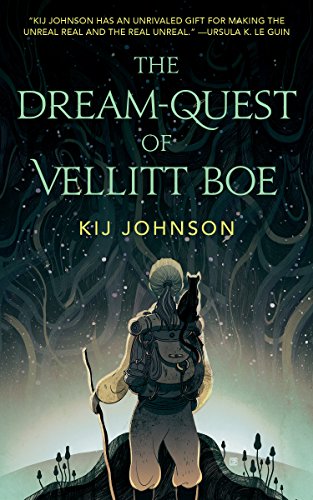
Mini-Review: The Dream-Quest of Vellitt Boe


I just completed reading Kij Johnson's The Dream-Quest of Vellitt Boe.  (disclaimer: Kij is a friend of mine, met through a mutual friend and rock climbing).

The book is a direct descendant of H.P. Lovecraft's Dream-Quest of Unknown Kadath, and takes place within Lovecraft's Dreamlands.  Vellitt Boe, a professor at the Ulthar Women's College (the town with the cats) is awoken one night with news that one of the college's star students has disappeared, running away with a 'dreamer' - a person from the 'waking world' - our Earth.  The two have a head start, and through machinations of their own, appear to have escaped back to the dreamer's homeland.

Professor Boe is tasked with finding an alternate way to escape the Dreamlands, track down the truant student, and return her to her native land.  Because, it appears, the young woman is more than simply a love-smitten student, and her disappearance could have catastrophic consequences for both Ulthar and the Dreamlands.

Johnson returns us to the terrain first laid out be Lovecraft in his Randolph Carter stories, among others.  Boe, in her quest, makes stops at many of these locales, revisiting the places, people, creatures, and mad godlings created by the influential writer.

And, indeed, in her back-tracking, Boe (and Johnson) reacquaints us with Lovecraft's geography, not through the eyes of a dreamer, but via those of a resident of that dark and often-horrific land.

Boe travels across the Dreamlands, seeking counsel and access from a number of personages, including a couple from her own past.  Her travels in pursuit of the lovers gives her moments to reflect on her own youthful travels and loves, before settling in as a staid professor of Mathematics at the college.

What the book does well, in its themes, is to return us to a point of inspiration and original discovery.  Johnson, in the liner notes, recalls first encountering Lovecraft in adolescence, and her own inspiration to return to those macabre lands.  Like many of us in writing, gaming, and other creative places - both taking inspiration, and wholesale re-tooling, from the artists who came before is part and parcel of the trade.  And, like many of us, the middle-aged Boe ruminates on her own past and path, and recalls her own adventures, both productive and foolish, which brought her to her current occupation and place in the world.  And, in spite of her dogged pursuit of the student, she has empathy for those passions of youth gone by.

All in all, a fun read, and a fine re-visitation of a geography and works that inspired many later writers and the genre.

Which reminds me, I need to re-read Kadath, myself...

And gugs never forget...


Sunday, November 20, 2016

A question of plate

Thesis:  First level PC fighters really shouldn't start out with the ability to afford plate.  Sure, they've got a massive 8-10 HP, so they need all the help they can get pretending to tank their way at the front of the party.

But that's not what that initial funnel is about, now?  It's about scrabbling through that first dungeon, avoiding the giant frog, learning how to skulk and retreat, and getting out with enough coin to get that coveted equipment upgrade...

So let's take a quick review of where a few version of the game sit with respect to the economy of armor.

For consistency, I'm just looking at the three basic armor types that are persistent through various versions of the game (at least the ones that I have laying about right now) - leather, chain mail, and plate mail.

The Moldvay/Cook books line out leather, chain, and plate at 20, 40, and 60 gp, respectively.

S&W spreads out the cost a bit more - 5, 75, and 100 gp.

Basic Fantasy prices the three types at 20, 60, and 300 gp.

1st ed. AD&D puts them at 5, 75, and 400 gp.

Labyrinth Lord costs are 20, 150, and 600 gp.

In the first case, an average-rolling PC (120-130 gp on a 3d6x10) can afford plate.  S&W can make plate available for strongly-rolling 1st level PCs, unless they skimp on other accouterments and supplies.  And plate is out of reach for 1st level characters in BFRPG, AD&D, and Labyrinth Lord

(Later on, 3.5/Pathfinder makes most medium and all heavier armors out of reach for 1st level characters, and perhaps even for 2nd or 3rd level depending on their treasure hauls: 10, 150, 600 for 'half-plate'/1,200 for 'field plate'/1,500 for 'full plate'.)

I doubt that many of these values have much grounding in any 'real' economy. There are limited resources on the historical prices of armor.  However, here is one that lists out some example costs for a few common armor types (typically chain mail, a few helmets, partial armor bits like curiasses, as well as some values for custom armor made for nobles.)

Anyway let's move on to starting GP for 1st Level PCs:

Prior to 1st Ed. AD&D, all character classes rolled the same starting gold - 3d6x10 GP. The OSR clones generally stick with this model.

Of course, we probably can all recall more than once a magic user PC rolling high and buying out the town market's daggers, oil and pack animals.  And a fighter rolling 40 GP and gamely heading out of town in their leather and spear, with a bag over their shoulder.

Then comes AD&D, and the starting gold values get skewed by class.

This skewing is not simply starting GP as buying power, it is also proportional to the types of equipment required/allowed by the classes.

But... perhaps another way to think about these variable starting gold values may actually be as part of the backstory for the individual PC.

Sunday, October 16, 2016

Corrupted Potions

Another bit of rumination on Potions and their sensitivity to the environment around them, in contribution to Of Dice and Dragons' October RPG Blog Carnival topic.

Part 1 here.


While there are a number of spell failure tables and mechanics are available, I don't know if there are any for potions (or I'm just lazy and never looked).

I would theorize that, although potions are typically treated as infallible 'magic bullet' items in game-playing, that in 'reality' they may be more unreliable - concoctions brewed by sketchy alchemists, or enchanted by second-rate mage's assistants...

Additionally, if the potion is considered a distillation enchanted with a spell effect, would the fluid be susceptible to magical influences?

So... A consideration of a few things, in no particular order, that may have an effect on a lowly potion, minding its own business in its flask or vial....