I recently found the Thomas Covenant trilogy at Goodwill, and since I had never read the books, picked them up.
The trilogy is regarded as influential in the fantasy genre, particularly for its archetypal anti-hero, or unlikable, unwilling hero in the form of Thomas Covenant. He is a depressive, divorced author suffering from leprosy, who is periodically torn from the modern world and tossed into the fantasy world of "The Land." Disoriented, full of doubt, and self-loathing (hence his nickname, 'The Unbeliever'), he is mistaken as a reincarnated hero from a past conflict.
And I can't get through these books.
Slogged through Lord Foul's Bane, and am currently about halfway through The Illearth War. Hile Troy and his small force are approaching Doom's Retreat for what is, at best, a delaying action. And Covenant is tagging after High Lord Elena in search of the Seventh Ward, a power that the Lords are not prepared to wield.
Gawd, these books are interminable reads.
I understand that Covenant is meant to be an unlikable character, and was prepared for that (I've read/enjoyed plenty of other anti-hero centered novels). But I find the writing turgid and melodramatic, and none of the 'good guys' to be engaging or sympathetic. I suspect that I need more context on Donaldson's influence or subtext, but so far this experience has moved far into the territory of books I "should" read, rather than I "want" to read.
Apropos, io9 just posted this article on the Rule of 50 for when to abandon a read.
So I'm setting Tom aside for a more attractive and relevant read. Perhaps I'll return to the trilogy, to skim through the rest of Illearth, and take on The Power That Preserves another time.
(Similarly, I've often joked that Harvard Lampoon's 'Bored of the Rings,' which pares down the LOTR trilogy into a single volume, while somehow not apparently losing any significant content, is the length that the original trilogy 'should' have been.)
Any similar observations, experiences or context?
Tuesday, December 30, 2014


Monday, December 29, 2014
Lubella, Expanded Petty Gods
Opened my damn fool mouth and Richard LeBlanc told me he had a gap in his Expanded Petty Gods project. Per Richard:
"HOWEVER! ... I have space in the "L" section for 1 more god. If you want to write the matching god too, that would be great. One catch, you have to start the god's name with the letters "Lu.""
OK.
Name: Lubella the Transformative
Symbol: Winged Cocoon
Alignment: Neutral
Mv: 120/30
AC: 3
hp/HD: 47/8
Atk: 1 (knout) + special
Dmg: 1d4+1 (+1hp/turn bleeding damage)
Save: Cl9 (+ hit only by magic weapons)
Morale: 5
Hoard: XIV
XP: 1060
Lubella resides as the God/dess of transformation. Worshipers petition her to assist in the commencement of new endeavors, or to smooth the way during significant or difficult transitions. Because of this, many adolescents find need to seek her out, causing her to be derisively referred to as the god/dess of the awkward teen years.
Androgynous, she either appears as a human of indistinct gender, or alternates between a stubbly boy and an awkward girl, depending on the moment or the angle of the viewer.
She is a sympathetic god/dess, sensitive to those in transformation or growth. However, she also recognizes that she will have few lifetime adherents, and often feels abandoned when a worshiper's change is complete. Since this worship is typically short-lived and specific to a period or event, she may feel slighted at not receiving due thanks.
When bored, Lubella may also appear spontaneously at a cross-roads or along a tortuous path as an adolescent beggar. Tossing a coin or two and saying a few kind words may be sufficient for her to point out the preferred route before disappearing. Insulting or ignoring her will cause her to give incorrect directions if asked. More egregious insults will result in her casting confusion upon the disrespectful individual(s) (see below).
"HOWEVER! ... I have space in the "L" section for 1 more god. If you want to write the matching god too, that would be great. One catch, you have to start the god's name with the letters "Lu.""
OK.
Name: Lubella the Transformative
Symbol: Winged Cocoon
Alignment: Neutral
Mv: 120/30
AC: 3
hp/HD: 47/8
Atk: 1 (knout) + special
Dmg: 1d4+1 (+1hp/turn bleeding damage)
Save: Cl9 (+ hit only by magic weapons)
Morale: 5
Hoard: XIV
XP: 1060
Lubella resides as the God/dess of transformation. Worshipers petition her to assist in the commencement of new endeavors, or to smooth the way during significant or difficult transitions. Because of this, many adolescents find need to seek her out, causing her to be derisively referred to as the god/dess of the awkward teen years.
Androgynous, she either appears as a human of indistinct gender, or alternates between a stubbly boy and an awkward girl, depending on the moment or the angle of the viewer.
She is a sympathetic god/dess, sensitive to those in transformation or growth. However, she also recognizes that she will have few lifetime adherents, and often feels abandoned when a worshiper's change is complete. Since this worship is typically short-lived and specific to a period or event, she may feel slighted at not receiving due thanks.
When bored, Lubella may also appear spontaneously at a cross-roads or along a tortuous path as an adolescent beggar. Tossing a coin or two and saying a few kind words may be sufficient for her to point out the preferred route before disappearing. Insulting or ignoring her will cause her to give incorrect directions if asked. More egregious insults will result in her casting confusion upon the disrespectful individual(s) (see below).
Lubella will typically flee from aggression or combat. If pressed, she will let loose a blood-curdling scream to cover her retreat. Creatures within a 30' cone before her will be stunned for 2d4 rounds (-4 to hit, movement –50%). If she does have to engage in combat, she will strike out with a barbed knout that she keeps tied around her waist.
Reactions(2d6: subject to mendicant's CHA bonus):
2: Incensed. Confusion/transition impeded or prolonged, perhaps even cursed...
3-5: Insulted, leaves in huff. Insulting individual made awkward, prone to inappropriate outbursts for 1 day.
6-9: Neutral. Bored, rolls eyes. Did you just ask her to come all this way to help with that? Decides to hang out a bit to see what happens.
10-11: Shrugs, generally agreeable. Points out best course or action or direction.
12: Totally psyched. Blesses endeavor.
2: Incensed. Confusion/transition impeded or prolonged, perhaps even cursed...
3-5: Insulted, leaves in huff. Insulting individual made awkward, prone to inappropriate outbursts for 1 day.
6-9: Neutral. Bored, rolls eyes. Did you just ask her to come all this way to help with that? Decides to hang out a bit to see what happens.
10-11: Shrugs, generally agreeable. Points out best course or action or direction.
12: Totally psyched. Blesses endeavor.
Friday, December 26, 2014
12 Found Deeds
Property deeds, that is. Perhaps found on a body, lifted from a pocket, or willed by a distant and forgotten relative...
1. ...to an old stronghold at the edge of a once-fertile land, now dead, desecrated and referred to simply as The Blight. Anyone taking claim on the property will need to spend great time and effort to restore and re-sanctify the land back to productivity.
2. ...to an ancestral estate and farmland, renowned for its bumper rye crops. Still productive, but suffering from a bit of a bulette infestation.
3. ...to a manorhouse lovingly maintained by an aged, deaf groundskeeper and custodian. Uninhabitable due to the constantly screaming ghosts.
4. ...to a seaside tower, formerly a wizard's redoubt, and now a popular spot for viewing the annual kraken migration.
5. ...to a shabby hut huddled in a dank grove. Which, upon recitation of incantations on a second scroll (to be found/obtained separately), reveals a gateway to a pocket universe, and a resplendent mansion situated on a transparent platform overlooking an alien, starry expanse.
6. ...to a played-out mine. Un-maintained, it is crumbling, with bowed shoring and collapsed tunnels. Further exploration and mining has a chance to break through to a crystal-veined cave, filled with gems highly sought-after for their ability to store arcane energies.
7. ...to a giant, alien god-skull, set high upon an arid cliff. The brain cavity has been divided into rooms, and the eye sockets paneled with stained glass depicting legendary crimes.
8. ...to a lovely little hamlet and the surrounding lands up the coast a ways. All the tenant-farmers are friendly, productive, and thoroughly undead.
9. ...to ancestral lands and their ancient dolmen-rings. Which, unfortunately, has been co-opted by bugbear shamen, claiming that it, too, is their traditional holy site. They may be willing to negotiate shared access, but have a long list of requirements (some contradictory) for avoiding desecration of the site for their beliefs.
10. ...to a fungal regime in the understory of a deep rainforest. The allegiance of the giant leaf-cutter ant colony is not guaranteed.
11. ...to a mega-dungeon complex left by a distant and forgotten lich-uncle. Stipulations for acquiring the property include; converting alignment to chaotic, maintenance of dark rituals to assure alliance of minion-troops, and preservation of the structure in accordance to Hegemonic Register of Historic Places guidelines.
12. ...to a giant treehouse complex suspended within a Methuselah tree in a primordial forest. The place is rustic, yet resplendent. And terribly infested by pixies.
 |
| source |
1. ...to an old stronghold at the edge of a once-fertile land, now dead, desecrated and referred to simply as The Blight. Anyone taking claim on the property will need to spend great time and effort to restore and re-sanctify the land back to productivity.
2. ...to an ancestral estate and farmland, renowned for its bumper rye crops. Still productive, but suffering from a bit of a bulette infestation.
3. ...to a manorhouse lovingly maintained by an aged, deaf groundskeeper and custodian. Uninhabitable due to the constantly screaming ghosts.
4. ...to a seaside tower, formerly a wizard's redoubt, and now a popular spot for viewing the annual kraken migration.
5. ...to a shabby hut huddled in a dank grove. Which, upon recitation of incantations on a second scroll (to be found/obtained separately), reveals a gateway to a pocket universe, and a resplendent mansion situated on a transparent platform overlooking an alien, starry expanse.
6. ...to a played-out mine. Un-maintained, it is crumbling, with bowed shoring and collapsed tunnels. Further exploration and mining has a chance to break through to a crystal-veined cave, filled with gems highly sought-after for their ability to store arcane energies.
7. ...to a giant, alien god-skull, set high upon an arid cliff. The brain cavity has been divided into rooms, and the eye sockets paneled with stained glass depicting legendary crimes.
8. ...to a lovely little hamlet and the surrounding lands up the coast a ways. All the tenant-farmers are friendly, productive, and thoroughly undead.
9. ...to ancestral lands and their ancient dolmen-rings. Which, unfortunately, has been co-opted by bugbear shamen, claiming that it, too, is their traditional holy site. They may be willing to negotiate shared access, but have a long list of requirements (some contradictory) for avoiding desecration of the site for their beliefs.
10. ...to a fungal regime in the understory of a deep rainforest. The allegiance of the giant leaf-cutter ant colony is not guaranteed.
11. ...to a mega-dungeon complex left by a distant and forgotten lich-uncle. Stipulations for acquiring the property include; converting alignment to chaotic, maintenance of dark rituals to assure alliance of minion-troops, and preservation of the structure in accordance to Hegemonic Register of Historic Places guidelines.
12. ...to a giant treehouse complex suspended within a Methuselah tree in a primordial forest. The place is rustic, yet resplendent. And terribly infested by pixies.
Monday, December 22, 2014
Random Magic Item: Sacred Pears of Leir
Mentioned briefly here:
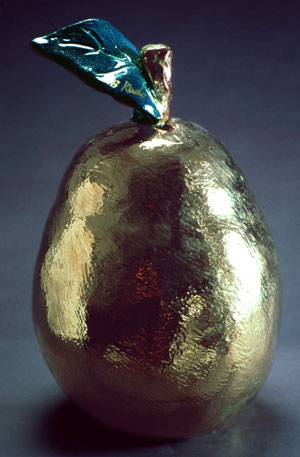
The Sacred Pear of Leir is a rare druidic item enchanted to bring healthy and bountiful crops to those who still follow the old ways. As such, a Pear is a valuable commodity, and the fortunes of many an agricultural region have hinged on the acquisition or loss of one of these rare, beneficial artifacts.
Benefit is gained through a ritual involving anointing the Pear with a mixture of honey and blood at a critical juncture in the maturation of the local crop. This may take place during sprouting, flowering, first fruits, or another event, dependent upon the crop. Although the power of the Pear does not guarantee a bumper crop, it will minimize conditions that may lead to crop damage or failure - insects, hail storms, drought, rusts. It does not have power over anthropogenic hazards, so the raiding orcs or barbarians may yet put the fields to the torch.
Honey used for the ritual must be harvested from an active, undamaged hive in such a way that the unprotected (often naked) collector is not stung once. Only the gentlest and most empathetic 'bee whisperers' can complete this feat. Typically the blood is provided by a sacrificed goat or calf; however, King Rishom of Athyr made a more considerable investment, sacrificing his daughter Oma to the Pear, in hopes of staving off famine and saving his kingdom. Indeed, he kept his people from starving, but still lost the kingdom anyway, as the people deemed his sacrifice too great, breaking down the castle gates and casting him from a tower. In the lawlessness and looting that followed, the Pear disappeared into the shadows.
As a rare and in-demand storied item, there are plenty of counterfeits available, often for sale or trade from the backs of caravans. These mountebanks assure the potential purchaser that this is a genuine Pear, acquired through obscure, and perhaps odious, means. None of the counterfeits have any powers, and are of varying quality, from cheap plated wood or base metal to solid gold (5 GP to 150 GP value). But belief is a strong sales-person, and although the Church frowns on such trinkets and rituals, many a farming village will have a quiet shrine, tucked away in some garden or copse, with a Pear (real or false) in residence.
The Sacred Pear of Leir is a rare druidic item enchanted to bring healthy and bountiful crops to those who still follow the old ways. As such, a Pear is a valuable commodity, and the fortunes of many an agricultural region have hinged on the acquisition or loss of one of these rare, beneficial artifacts.
 |
| source |
Honey used for the ritual must be harvested from an active, undamaged hive in such a way that the unprotected (often naked) collector is not stung once. Only the gentlest and most empathetic 'bee whisperers' can complete this feat. Typically the blood is provided by a sacrificed goat or calf; however, King Rishom of Athyr made a more considerable investment, sacrificing his daughter Oma to the Pear, in hopes of staving off famine and saving his kingdom. Indeed, he kept his people from starving, but still lost the kingdom anyway, as the people deemed his sacrifice too great, breaking down the castle gates and casting him from a tower. In the lawlessness and looting that followed, the Pear disappeared into the shadows.
As a rare and in-demand storied item, there are plenty of counterfeits available, often for sale or trade from the backs of caravans. These mountebanks assure the potential purchaser that this is a genuine Pear, acquired through obscure, and perhaps odious, means. None of the counterfeits have any powers, and are of varying quality, from cheap plated wood or base metal to solid gold (5 GP to 150 GP value). But belief is a strong sales-person, and although the Church frowns on such trinkets and rituals, many a farming village will have a quiet shrine, tucked away in some garden or copse, with a Pear (real or false) in residence.
Many false Pears have had some cheap enchantment cast upon them so they exude magic if tested by a simple detect magic spell or similar. A genuine Pear may be identified through use of read magic. When cast, the phrase "fecunditatis abundat" appears on the surface of the Pear. This fact is not widely known, and such information would be extremely valuable to an individual or group seeking a true Pear.
Thursday, December 18, 2014
Petty Gods "Minions Speed Rounds," continued...
Richard offered up a few more beings for backstories, abilities and deities served:
Milduitic
No. Encountered: (2d4)
Alignment: Neutral
Movement: 120'/50'
Armor Class: 6
Hit Dice: 3+1
Attacks: 1
Damage: Glaive (1d10+1) or Falchion (1d8+1)
Save: F5
Morale: 11
Hoard Class: nil, however, typically guarding temple or similar
XP: 90
The Milduitic are found impassively guarding remote desert tombs and temples in honor of various insectoid gods and godlets. Created for, and tasked with, this role, they are above bribery and will resolutely defend their responsibility with force of arms. Additionally, their mysterious creators took certain precautions in making reliable guards, and the Milduitic are immune to charm spells, and save vs. sleep at +2.
Milduitic appear as burly humanoids, with yellowish skin the color of aged bruises and lustrous black carapace-skulls. They speak in a high-pitched chittering, clicking language of their own. The language is partially beyond human hearing range, and they may appear silent, in spite of communicating with one another, or attempting to communicate with trespassers.
 Taartkin
No. Encountered: (1d2)
Alignment: Chaotic
Movement: 120'/50'
Armor Class: 8
Hit Dice: 1-1
Attacks: 1
Damage: Thrown pie (1d2)
Save: Th1
Morale: 5
Hoard Class: II
XP: 13
Taartkin are skittering, mincing servitors to those dark forces that halflings fear most - those of the fallen cakes and filched pies. Prowling in the bushes near the burrow-holds, the Taartkin use foul powers granted by these dark forces to make bread rise unevenly, to cause cakes to fall at critical moments, and to ruin the crusts of pies. Halfling hearth-priests keep a sharp eye out for the glowing eyes of these nocturnal, four-armed lurkers, who swipe baked offerings for submission to their own gods, as they do not bake any goods of their own.
(This minion was an inadvertent duplicate entry, but will possibly show up revised and with a different illustration)

Vedelris Valkayne
No. Encountered: 1
Alignment: Chaotic
Movement: 120'/50' (walk); 180'/60' (fly)
Armor Class: 5
Hit Dice: 5
Attacks: 1
Damage: Bow (1d6+1d4 fire damage), Scimitar (1d8), fire damage (1d6/round for creatures within 10 feet)
Save: MU6
Morale: 10
Hoard Class: nil
XP: 135
Dark-eyed winged enforcer of the fire plane and associated Deities, Vedelris is dispatched to exact retribution, collect debts, and confirm that rites and sacrifices are being properly followed. Appearing as a slight, winged man of serious demeanor, Vedelris will burst forth, ringed in flame. His initial appearance will have equivalent fear effect for those who do not save vs. spells. Often, his appearance alone will have sufficient effect on the malleable minds of worshippers. If he finds the situation not meeting his criteria, or he is met with resistance, he may lay forth with his bow, firing flame-wreathed arrows. Any creatures closing within 10 feet will receive 1d6 fire damage per round. As a fire-based creature, Vedelris is immune to fire-based attacks and non-magical weapons. "Killing" him will dispel him back to his native plane.
(this fellow is for a lightning round allowing multiple entries for a single illustration)
 |
| Art via Jason Sholtis |
No. Encountered: (2d4)
Alignment: Neutral
Movement: 120'/50'
Armor Class: 6
Hit Dice: 3+1
Attacks: 1
Damage: Glaive (1d10+1) or Falchion (1d8+1)
Save: F5
Morale: 11
Hoard Class: nil, however, typically guarding temple or similar
XP: 90
The Milduitic are found impassively guarding remote desert tombs and temples in honor of various insectoid gods and godlets. Created for, and tasked with, this role, they are above bribery and will resolutely defend their responsibility with force of arms. Additionally, their mysterious creators took certain precautions in making reliable guards, and the Milduitic are immune to charm spells, and save vs. sleep at +2.
Milduitic appear as burly humanoids, with yellowish skin the color of aged bruises and lustrous black carapace-skulls. They speak in a high-pitched chittering, clicking language of their own. The language is partially beyond human hearing range, and they may appear silent, in spite of communicating with one another, or attempting to communicate with trespassers.
No. Encountered: (1d2)
Alignment: Chaotic
Movement: 120'/50'
Armor Class: 8
Hit Dice: 1-1
Attacks: 1
Damage: Thrown pie (1d2)
Save: Th1
Morale: 5
Hoard Class: II
XP: 13
Taartkin are skittering, mincing servitors to those dark forces that halflings fear most - those of the fallen cakes and filched pies. Prowling in the bushes near the burrow-holds, the Taartkin use foul powers granted by these dark forces to make bread rise unevenly, to cause cakes to fall at critical moments, and to ruin the crusts of pies. Halfling hearth-priests keep a sharp eye out for the glowing eyes of these nocturnal, four-armed lurkers, who swipe baked offerings for submission to their own gods, as they do not bake any goods of their own.
(This minion was an inadvertent duplicate entry, but will possibly show up revised and with a different illustration)
Vedelris Valkayne
No. Encountered: 1
Alignment: Chaotic
Movement: 120'/50' (walk); 180'/60' (fly)
Armor Class: 5
Hit Dice: 5
Attacks: 1
Damage: Bow (1d6+1d4 fire damage), Scimitar (1d8), fire damage (1d6/round for creatures within 10 feet)
Save: MU6
Morale: 10
Hoard Class: nil
XP: 135
Dark-eyed winged enforcer of the fire plane and associated Deities, Vedelris is dispatched to exact retribution, collect debts, and confirm that rites and sacrifices are being properly followed. Appearing as a slight, winged man of serious demeanor, Vedelris will burst forth, ringed in flame. His initial appearance will have equivalent fear effect for those who do not save vs. spells. Often, his appearance alone will have sufficient effect on the malleable minds of worshippers. If he finds the situation not meeting his criteria, or he is met with resistance, he may lay forth with his bow, firing flame-wreathed arrows. Any creatures closing within 10 feet will receive 1d6 fire damage per round. As a fire-based creature, Vedelris is immune to fire-based attacks and non-magical weapons. "Killing" him will dispel him back to his native plane.
(this fellow is for a lightning round allowing multiple entries for a single illustration)
Subscribe to:
Posts (Atom)